This blog explains how a CMMC Security Assessment Policy helps organizations validate their security controls, monitor risks, and prepare for compliance assessments. It covers key areas like continuous monitoring, POA&M management, SSP documentation, and security control testing to help organizations build a stronger and more defensible security program.
Key Takeaways
✅ Learn how a CMMC Security Assessment Policy supports ongoing control validation and audit readiness.
✅ Understand the role of SSPs, POA&Ms, and continuous monitoring within a mature compliance program.
✅ Discover how structured assessments help identify weaknesses before auditors or attackers do.
Who Should Read This?
This guide is ideal for defense contractors, compliance leaders, IT managers, and organizations working toward CMMC Level 2 compliance. It’s especially useful for teams struggling to document assessments, maintain SSP accuracy, or manage remediation efforts through POA&Ms.
Security Assessment Domain
The Security Assessment (CA) domain is the "report card" for your security program. It is the "trust but verify" part of your program. While other domains establish controls, this domain requires you to test those controls. It moves security from a list of promises to a proven set of defenses.
You must create a plan to test your security controls. You must assess your systems to prove that your defenses meet your goals. You must also document these results in a formal report. Security is not a one-time event. You must watch your systems to detect changes or new threats. If you find a weakness, you must track it within a plan of action.
Your plan documents how you will fix the problem, who is in charge, and a remediation timeline. Checking your own work protects you against surprises found by an auditor or a hacker. You have evidence that your controls are effective. Leaders can make better decisions when they see clear reports on system risks. Tracking your fixes ensures that your security gets stronger every month.
Policy Writing
Domain level policies address the controls implemented within systems and organizations. Policies are the perfect home to define control parameters, such as frequencies. Procedures describe the implementation of policies or controls. Organizations may document procedures within the system security plan or within separate documents. Here are some of the principles that guided this security assessment policy:
Restating controls does not constitute an organizational policy or procedure.
Policies should omit references to specific technologies.
Address procedures to the individual or role performing the task.
Use plain language when writing procedures and avoid technical jargon.
Policy Structure
A cover page tracks specific details regarding the policy, including:
Version - number capturing major and minor policy revisions
Effective Date - date of policy dissemination
Last Review Date - date the policy was last reviewed
Next Scheduled Review Date - the date for the next mandatory policy evaluation
Classification - internal categorization of the policy’s sensitivity for confidentiality
NIST SP 800-53 defines specific objectives for domain-level policies. From this guidance we incorporate the following major sections into our policy:
The purpose statement should identify why the policy exists and what it aims to achieve.
The scope should identify who it applies to and under what circumstances.
The policy governance section covers most of the organization defined parameters. These subsections cover the following details:
Policy Dissemination List - defines roles or personnel to disseminate the policy
Procedure Dissemination List - defines roles or personnel to disseminate the procedures
Policy Owner - defines an official to management the policy and supporting procedures
Policy Review Frequency - how often the organization reviews and updates the policy
Policy Review Triggers - events that require an out-of-cycle policy review or update
Procedure Review Frequency - how often the organization reviews and updates the procedures
Procedure Review Triggers - events that require an out-of-cycle procedure review or update
The fourth section includes our policy statements. Subsection headings group related Policy statements together. Each policy statement has a unique number for traceability to other documents. A policy statement number consists of the section, subsection, and policy statement order.
The fifth section identifies the relevant roles and responsibilities identified in the policy. A single, short paragraph describes the responsibilities for each role. The sixth section identifies the supporting procedures. We opted to align our subsection headings with the names of supporting procedures. The seventh section identifies related documents, to include relevant policies. The eighth section documents a revision history. This table captures policy changes, including: version, effective date, approver(s), change summaries. The ninth section captures a formal authorization of the policy by the policy owner.
Policy Statements
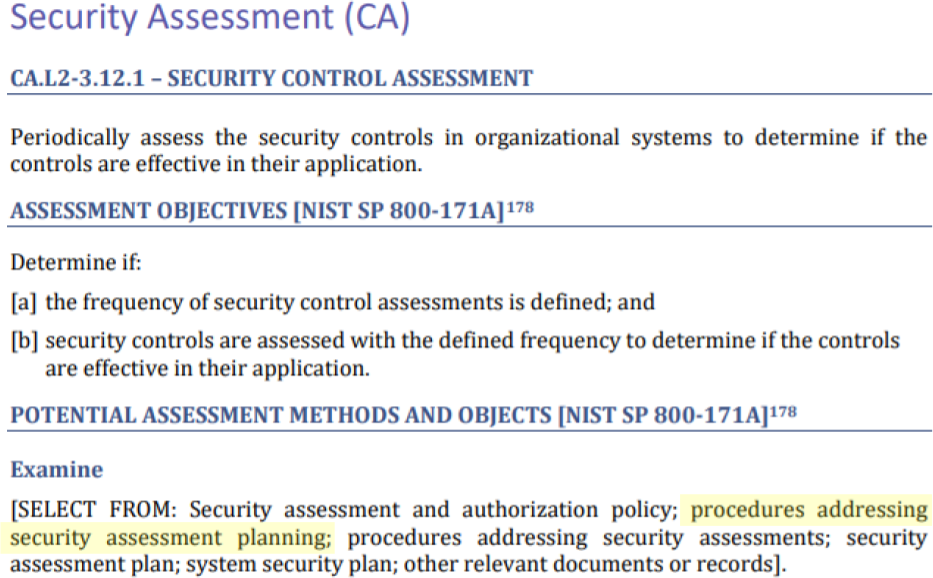
NIST identified a named set of procedures for each practice within NIST SP 800-171. The assessment guide (SP 800-171A) contains the original mappings. The CMMC assessment guides include this mapping as well. The potential assessment methods and objects section contains a subsection called examine. Within each practice, NIST identified relevant policies, procedures and other artifacts. We used the relevant procedures to organize the section headings within each policy.
At a minimum, all security controls shall be reviewed and assessed for effectiveness at least once annually.
The organization shall employ independent assessors or assessment teams to conduct annual control assessments. To maintain impartiality, assessors shall be free from any perceived or actual conflicts of interest regarding the development, operation, or management of the systems under assessment. This independence may be achieved through the use of external third-party auditors (e.g., a 3PAO or C3PAO) or by utilizing internal personnel who do not have day-to-day operations or maintenance responsibilities for the controls being tested.
If a control is found to be ineffective or degraded, immediate action shall be taken to restore its functionality. The results of continuous monitoring activities, including any identified deficiencies, shall be reported to the CISO and relevant stakeholders to inform risk management decisions and update the Plan of Action and Milestones (POA&M).
CMMC Objectives Covered in This Section:
(2) objectives from CA.L2-3.12.1
(1) objective from CA.L2-3.12.2
Plan of Action and Milestones
If a system vulnerability or a security control deficiency is discovered through assessments, continuous monitoring, or external audits, and an immediate solution is not available, the issue must be documented in a Plan of Action and Milestones (POA&M).
POA&Ms shall be developed and implemented to provide a structured approach for correcting system deficiencies and reducing or eliminating vulnerabilities. Each entry in the POA&M must include the planned remedial actions and the milestones for completion. The POA&M serves as the authoritative record for risk-based remediation and shall be used by the CISO to prioritize resource allocation for security improvements.
POA&Ms must be updated at least quarterly to reflect progress made toward remediation, record completed tasks, and adjust timelines for remaining deficiencies. This ensures that the organization maintains a transparent and proactive posture regarding its security gaps.
CMMC Objectives Covered in This Section:
(3) objectives from CA.L2-3.12.2
Continuous Monitoring
Controls identified as having a higher risk of failure, or those protecting critical Controlled Unclassified Information (CUI), shall be subject to a more frequent monitoring schedule as defined and documented in the System Security Plan (SSP). Security controls shall be monitored on an ongoing basis by independent assessors or assessment teams to ensure their continued effectiveness in protecting organizational systems and data. This monitoring process involves impartial testing and verification, conducted by personnel with no direct responsibility for system operation or management, to ensure that controls are operating as intended and producing the desired outcome. Continuous monitoring activities shall focus on identifying systemic security flaws and ensuring that the organization maintains its established security baseline. The findings from these assessments shall be integrated into the annual Risk Assessment report.
CMMC Objectives Covered in This Section:
(1) objective from CA.L2-3.12.3
Security Plan Development and Implementation
One or more System Security Plans (SSP) shall be developed and maintained to serve as the formal documentation of the organization’s security posture. Each SSP must clearly describe the system boundaries, the system environment of operation, and the relationships with or connections to other internal or external systems. The SSP shall include an accurate inventory of system components and a network diagram clearly illustrating CUI data flow and system boundaries.
The SSP shall detail how each NIST SP 800-171 security requirement is implemented within the environment. For any requirements identified as non-applicable, the SSP must provide a formal justification explaining why the control does not apply to the specific system or environment.
The SSP(s) shall be reviewed and updated at least annually or upon significant changes to the system environment. This review process must confirm that all security requirements are correctly applied and remain effective in protecting the information system. The SSP shall be updated as necessary to accurately reflect the current implementation of security controls.
The SSP shall be formally approved and signed by the CISO upon initial completion and after every major revision.
CMMC Objectives Covered in This Section:
(8) objectives from CA.L2-3.12.4
Syncing Policies with System Security Plan
FedRAMP guidance on how to write a control implementation statement states the following:
Implementation statements should reference supporting policies and procedures.
If a document is long, point to the exact sections that matter instead of the whole thing.
Write summaries so that reviewers don't have to go look up other documents.
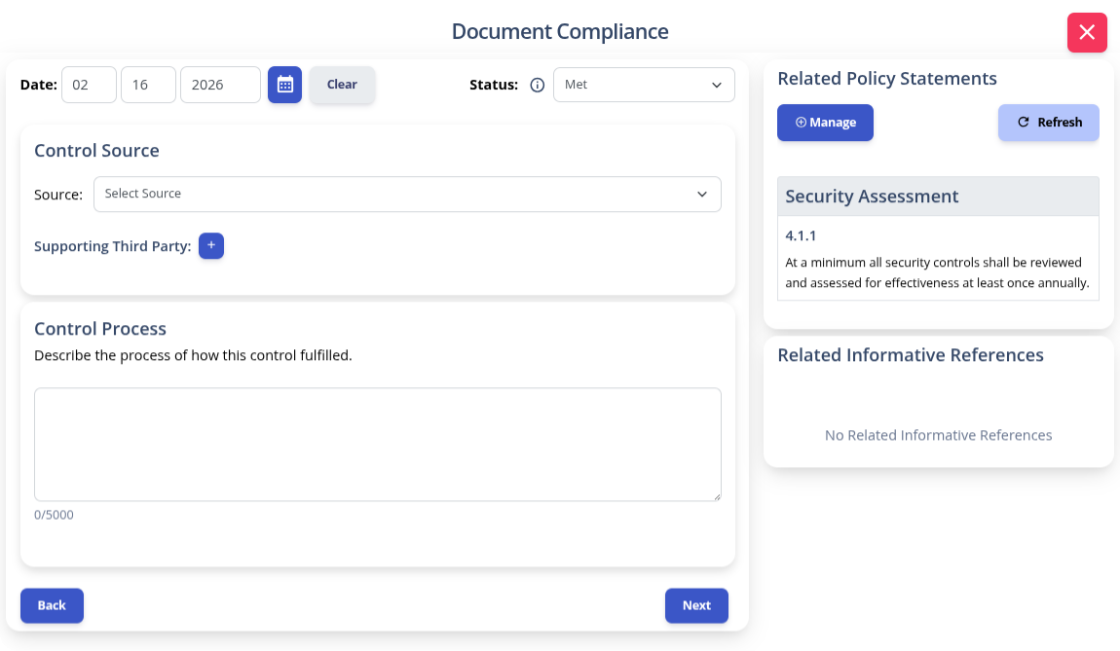
Write your policies before you start drafting your security plan. K2 GRC shows you exactly how each part of your policy connects to your security goals. This starts with selecting an objective to document.
After selecting a criteria, K2 GRC shows policy statements relevant to that criteria. The input screen shows the specific policy name and the statement’s number. This enables users to cite relevant policy sections within the control narratives. The system aggregates these control narratives to populate the system security plan (SSP).
Building a security program takes a lot of hard work, but without testing, how do you know it actually works?
It is stressful to wonder if a small mistake or a missed update has left your business open to a breach. You deserve to know that your hard work is paying off. Security Assessments replace that worry with facts. When you test your controls and track your progress, you gain more than a passing grade.
You gain the confidence that your data is safe and your team is ready. You stop reacting to problems and start leading with a clear vision. Don’t let the fear of a "bad report card" hold you back from greatness.
Our Security Assessment Policy template provides the framework to prove compliance. It takes the guesswork out of planning so you can focus on building a stronger, safer future.
❓ Frequently Asked Questions About CMMC Security Assessment Policy
What is a CMMC Security Assessment Policy?
A CMMC Security Assessment Policy defines how an organization reviews, tests, and validates its security controls. It helps prove that controls are working as intended and supports documentation for audits, SSPs, POA&Ms, and continuous monitoring.
Why is a security assessment policy important for CMMC compliance?
A security assessment policy is important because CMMC requires organizations to verify that security controls are effective, not just documented. It creates a repeatable process for assessing controls, identifying gaps, and tracking remediation.
What should be included in a CMMC Security Assessment Policy?
A CMMC Security Assessment Policy should include assessment planning, control review frequency, assessor independence, continuous monitoring, POA&M requirements, SSP updates, roles and responsibilities, and policy review requirements. These sections help organizations show how they test controls and manage deficiencies.
How often should security controls be assessed for CMMC?
Security controls should typically be assessed at least annually, or more often when risks, system changes, or compliance requirements demand it. Higher-risk controls or systems that protect CUI may require more frequent monitoring.
How does a security assessment policy support the SSP?
A security assessment policy supports the System Security Plan by documenting how controls are reviewed, tested, and maintained. The results of these assessments help keep the SSP accurate and show whether each control is operating effectively.
What is the connection between security assessments and POA&Ms?
Security assessments help identify weaknesses, gaps, or control deficiencies. When those issues cannot be fixed immediately, they should be documented in a POA&M with planned remediation actions, owners, milestones, and timelines.
Can a CMMC Security Assessment Policy template help prepare for an audit?
Yes, a CMMC Security Assessment Policy template can help organizations prepare for an audit by creating a structured starting point for documenting assessment activities. It helps reduce guesswork and ensures key topics like control testing, continuous monitoring, SSP updates, and POA&M tracking are addressed.
Learn how to build an AI risk management policy that addresses governance, risk appetite, AI security risks, regulatory requirements, and ongoing monitoring.
A risk register helps organizations identify, assess, and manage potential risks in one centralized place. Learn the key components of a risk register, how to create and maintain one, and how it supports a more proactive approach to risk management.