This blog explains how a CMMC Level 2 System Security Plan (SSP) helps defense contractors and organizations handling CUI meet CMMC requirements and prepare for assessments. It walks through the core components of an SSP, best practices for documenting security controls, and how to simplify the process with a downloadable template and K2 GRC.
Key Takeaways
✅ Understand the essential elements of a CMMC Level 2 SSP, including system scope, diagrams, inventories, and interconnections.
✅ Learn how to document all 320 NIST SP 800-171 assessment objectives and account for shared responsibilities with cloud providers.
✅ Discover how templates and K2 GRC can improve consistency, speed, and evidence management throughout the assessment process.
Who Should Read This?
This guide is ideal for defense contractors, cybersecurity teams, compliance managers, and organizations pursuing CMMC Level 2 certification. It's especially useful if you're struggling with creating a compliant System Security Plan, documenting control implementations, or preparing for a self-assessment or C3PAO assessment.
Title 32 of the Cybersecurity Maturity Model Certification (CMMC) program requires organizations to have a System Security Plan (SSP) in place at the time of a Level 2 self-assessment or third party assessment. The absence of an up to date SSP at the time of the assessment will result in an incomplete assessment finding and noncompliance with 48 CFR 252.204-7012.
In this blog, we’ll cover the basic tenets of an SSP, then provide you with guidance on how to write a SSP for CMMC Level 2 SSP. The downloadable resource provides a comprehensive CMMC Level SSP Word template featuring 135 pages of formatted placeholders mapped to the 320 NIST SP 800-171A assessment objectives.
Core Components of a SSP
Title 32 of CMMC defines a system security plan as a formal document that provides an overview of the security requirements for an information system or information security program and describes the security controls in place or planned for meeting those requirements. While CMMC defines the requirements, NIST SP 800-18 provides the standard for SSP architecture. The system security plan describes the components within the system, the environment in which the system operates, the implementation of security requirements, and the relationship with or connections to other systems.
Information System vs Information Security Program
Information security programs are organization-wide and may provide protection for information and information systems (NIST SP 800-37 Rev 2). Information security program plans supplement system security plans to cover the totality of security controls employed by the organization.
Larger enterprises establish information security programs to achieve a more consistent and scalable application of controls organization-wide. Common controls inherited by an information system are incorporated into system security plans by reference. The implementation details for common controls are provided in the artifacts developed by the common control providers that are made available to system owners.
An information system is a discrete set of information resources organized for the collection, processing, maintenance, use, sharing, dissemination, or disposition of information (NIST SP 800-171 Rev 2). NIST SP 800-171 security requirements apply to contractor information systems that: process, store, or transmit CUI; provide security protections for systems which process, store, or transmit CUI; or are not logically or physically isolated from systems which process, store, or transmit CUI. The CMMC Scoping Guide Level 2 defines logical and physical separation:
Logical separation prevents data transfer between physically connected assets (wired or wireless) by non-physical means such as software or network assets (e.g.,firewall, routers, VPNs, VLANs).
Physical separation occurs when assets have no connection (wired or wireless). Data transfer is only available through manual means (e.g., USB drive).
Several sections of the SSP template address the system authorization boundary, including the system scope, description of the system, placeholders for network, facility, and data flow diagrams, system component inventory, environment of operation, and system interconnections.
System Scope
The system scope table categorizes the scope according to the SPRS portal:
Enterprise. An information security system with a defined boundary used to execute an organization's mission. The organization has the responsibility for managing its own risks and performance.
Enclave. A set of system resources operating in the same security domain. These resources share the protection of a single, common, continuous security perimeter.
System Description
According to the initial public draft of NIST SP 800-18 Rev 2, the system description should provide a high-level overview of the system’s characteristics, its purpose, and how it supports the organization’s mission. This might include identifying technologies or factors that present additional security-specific risks, such as cloud-based services or “bring your own device” (BYOD) policies.
Environment of Operation
The SSP should describe the environment of operation within one to three paragraphs, which includes any environmental or technical factors that raise special security concerns (for example the use of mobile devices or wireless technology). NIST SP 800-70 provides four categories of nonfederal system environments:
Standalone - an environment consisting of devices managed as separate units
Managed - administrators have centralized control over various device settings
Specialized Security-Limited Functionality (SSLF) - systems that have higher threats and associated impacts, where security takes precedence over functionality.
Legacy Environments - contains older systems often with less secure communications.
Network Diagrams
Network diagrams identify the physical and logical locations of the system components in the authorization boundary. Identify components based on their roles in the system, such as application interfaces, information data stores, or development, test, and production environments. Account for all system components within the diagrams, whether they are located on-premises, hosted by an external system, virtualized on system host devices, physically or logically isolated or hosted by third-party service providers.
Facility Diagrams
Facility diagrams define protected physical spaces within facilities. These diagrams address scoping discussions related to step 1.3 of the CMMC Assessment Process (CAP).
Data Flow Diagrams
Data Flow Diagrams identify the direction of data exchanges and the components that receive and transmit data, including:
Where data is created
Where data enters and exits key internal boundaries
The flow of information that results from information exchanges with external organization systems.
System Component Inventory
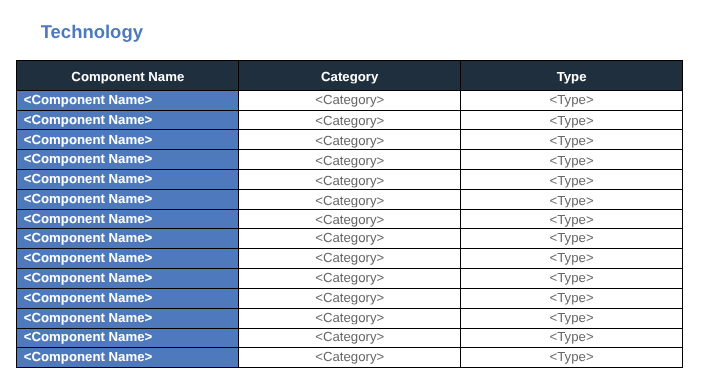
The Further Discussion section of CA.L2-3.12.4 states that the SSP must include a high-level description of the assets within the CMMC Assessment Scope. The CMMC Scoping Guide Level 2 states the SSP should document the treatment of assets within the CMMC Assessment Scope. Practitioners should categorize types of assets within the system and refer to any system element exactly the same way throughout the SSP. The image below shows a system technology component table that includes asset categorizations:
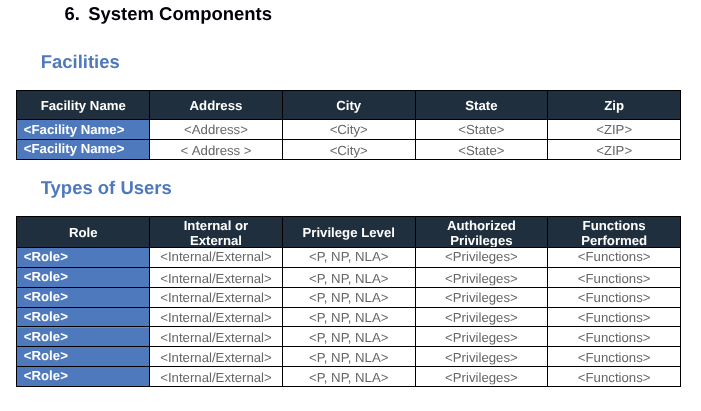
Keep in mind that system components should also define facilities and people. The image below shows tables to identify facilities and types of users within the system.
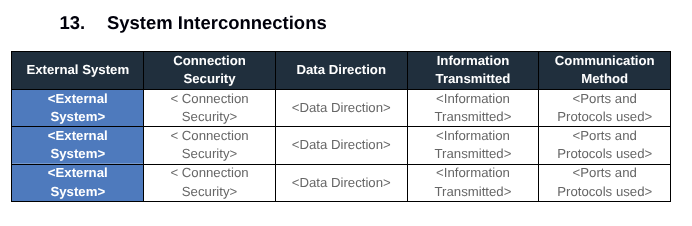
The system interconnections table describes the connections to external systems. For each external system interconnect, the table identifies the connection security (IPSec, VPN, etc.), the direction of data, the type of information transmitted, and the communication method (ports and protocols).
CMMC Level 2 contains 110 practices with 320 assessment objectives. In keeping with FedRAMP guidance and industry best practices, we recommend a focused discussion for each of the 320 assessment objectives. This isn’t an explicit requirement but put yourself in the assessor’s shoes for a moment. The assessment has 320 explicit objectives to review, it makes the assessor’s life much easier when the narrative focuses on each of those 320 objectives. Shared responsibilities and control scopes may require further additional segmentation of these 320 narratives.
Shared Responsibilities
Your system may include connections to or use of other authorization boundaries (AWS GovCloud, Microsoft Azure, Google Workspace, etc.). FedRAMP authorized cloud service providers should be able to provide you with a Customer Responsibility Matrix (CRM).
Ensure your system security plan explicitly details how your system meets the requirements assigned in the cloud service provider’s CRM. The SSP should address customer specific responsibilities consistently (e.g. addressed under a "Customer Responsibility" heading).
Control Scope
Your system may contain multiple platform components (Windows, Linux, etc.). Different platforms may have unique control configurations and FedRAMP guidance recommends using a standard format for addressing controls by platform within each applicable control part.
Example Implementation Description
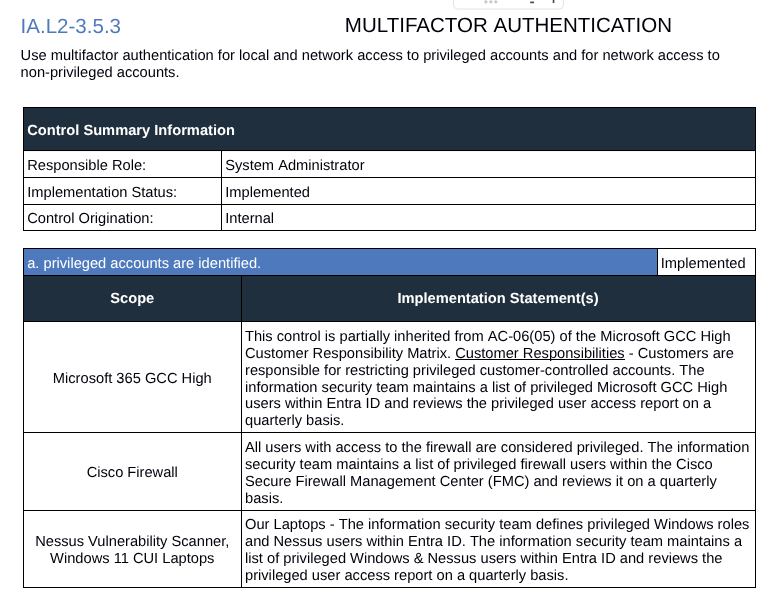
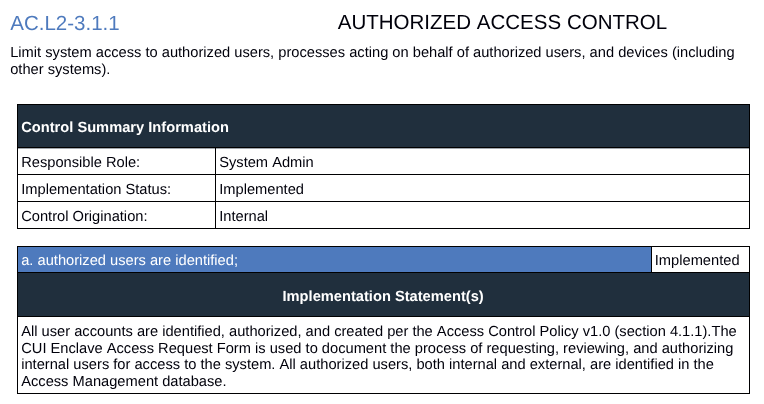
We designed this template to accommodate this separation of control implementation statements. The control summary table identifies the responsibility role, implementation status, and origination. The implementation status is a rollup of the status for each underlying assessment objective. The control origination identifies inherited, shared, or internal implementations of the control.
Below the control summary table are tables for each of the relevant assessment objectives. In this example, the scope includes various technology platforms within the system. This column allows for a narrative to describe the implementation of the assessment objective for each platform. The Microsoft 365 GCC High implementation statement references the customer responsibilities relevant to this assessment objective from the Customer Responsibility Matrix. Separate narratives describe the implementation relevant to the Cisco Firewall versus the Nessus Vulnerability Scanner and Windows 11 CUI Laptops.
According to the discussion of CA.L2-3.12.4 from CMMC Level 2 Assessment Guide, effective system security plans make extensive use of references to policies, procedures, and additional documents. Policies and procedures as well as supporting documents should be explicitly referenced by title, date, and version. If the entire referenced document does not apply, provide specific section references. Reviewers should not have to rely on following the references to understand the control implementation. Provide an overview of what the referenced document addresses so the SSP can stand on its own.
In the example shown below, we removed the scoping column as the narrative described the implementation across all platforms within the system. The narrative cites the relevant section of the Access Control Policy and describes how the control satisfies the requirement.
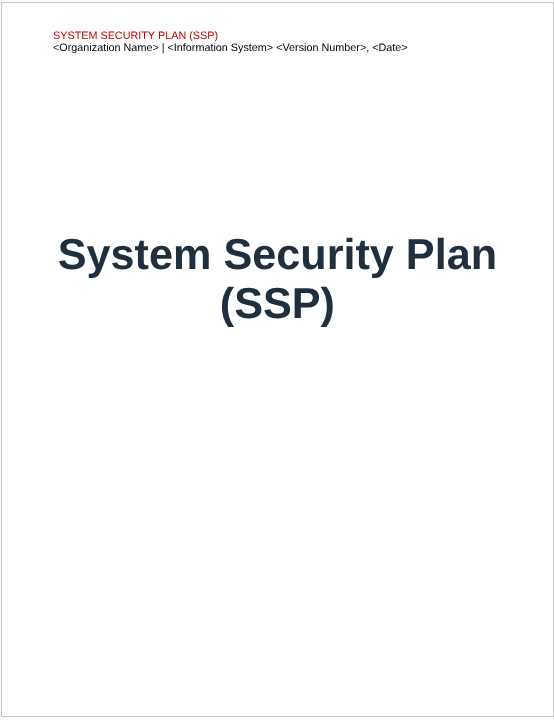
Now that we’ve covered the basic tenets of the SSP, here is a preview of the Word Document Template. The template includes a cover page, revision history table, a signature line for the authorizing official, a description of the system scope, placeholders for network, facility, and data flow diagrams, a table to categorize relevant information types, threats of concern and system contacts.
The System Security Plan is a complex document that brings together work from across teams. Instead of working through iterations of Word documents and tracking progress on an Excel workbook, K2 GRC provides teams with a workspace for methodically drafting, editing, and exporting a Word-based SSP.
This approach includes the following advantages:
Relationship Workspace - Instead of manually wrestling with a flat 135-page Microsoft Word file, K2 GRC provides a relational workspace to bring together scope, policies, and assessment objectives to improve consistency, accuracy, and speed.
Policy Mapping - by mapping existing policies to relevant assessment objectives, K2 GRC presents users with relevant content from their own policies as they draft their SSP.
Control and Assessment Objective scoping - organizations can adjust the scope of each requirement to account for shared responsibilities with cloud service providers or component-specific implementations across various platforms within the same system.
Crosswalking to other frameworks - K2 GRC supports a number of frameworks, including NIST SP 800-171 Rev 3 which will enable contractors to leverage work done under Revision 2 into the updated standard.
Task Management - document recurring continuous monitoring activities and relate them with relevant assessment objectives to incorporate artifacts into the body of evidence.
Open API Architecture and Automation - leverage prebuilt integrations to cloud services and SaaS platforms or use the open API architecture to establish your own automations.
Build a Body of Evidence - relate artifacts with assessment objectives to produce artifact maps and export the entire body of evidence into a hashed zip file for C3PAO assessments.
Native OSCAL Integration - K2 GRC supports the Open Security Controls Assessment Language (OSCAL). Our platform converts machine-readable compliance data directly into actionable dashboards, positioning you for the continuous authorization model championed by the new NIST SP 800-18 Rev 2 IPD.
Whether you’re starting out on your CMMC journey or updating your SSP post assessment, we hope you find the template helpful. The template contains 135 pages of formatted placeholders for you to describe the implementation of NIST SP 800-171 Rev 2 security requirements. As you establish your narratives, this template will grow to over 200 pages. If you find this content helpful, share it with your colleagues or follow us on LinkedIn for more helpful GRC-focused content.
❓ Frequently Asked Questions About CMMC Level 2 SSP
What is a CMMC Level 2 SSP?
A CMMC Level 2 SSP, or System Security Plan, is a formal document that describes how an organization protects systems that process, store, or transmit CUI. It outlines the system scope, security controls, implementation details, diagrams, inventories, and supporting documentation needed for a CMMC assessment.
Is an SSP required for CMMC Level 2?
Yes, an up-to-date SSP is required at the time of a CMMC Level 2 self-assessment or third-party assessment. Without one, the assessment may be marked incomplete, which can lead to noncompliance with CMMC and DFARS requirements.
What should be included in a CMMC Level 2 SSP?
A CMMC Level 2 SSP should include the system scope, system description, environment of operation, network diagrams, facility diagrams, data flow diagrams, system component inventory, system interconnections, and control implementation narratives. It should also reference related policies, procedures, evidence, and shared responsibility details when cloud services are involved.
How do you write an SSP for CMMC Level 2?
To write an SSP for CMMC Level 2, start by defining the system boundary and identifying the assets, users, facilities, and data flows in scope. Then document how each applicable NIST SP 800-171 security requirement and assessment objective is implemented, supported by policies, procedures, diagrams, and evidence.
How many assessment objectives are in CMMC Level 2?
CMMC Level 2 includes 110 practices and 320 assessment objectives based on NIST SP 800-171. A strong SSP should make it easy for assessors to understand how each requirement is implemented and where supporting evidence can be found.
Can a CMMC SSP template help with assessment preparation?
Yes, a CMMC SSP template can help organize the required sections, reduce formatting work, and make sure important system details are not missed. A template is especially helpful when documenting system boundaries, control implementations, shared responsibilities, and references to supporting evidence.
How does K2 GRC help create a CMMC Level 2 SSP?
K2 GRC helps teams build a CMMC Level 2 SSP in a structured workspace instead of managing a large Word document manually. It connects scope, policies, assessment objectives, tasks, evidence, and exports so teams can improve consistency and prepare more efficiently for CMMC assessments.
Risk management in healthcare helps organizations identify, assess, and reduce risks that can impact patient safety, compliance, operations, and finances. Learn practical strategies for building a proactive risk management program and prioritizing the risks that matter most.
The EU AI Act is reshaping how businesses build and use AI. Learn what the law requires, who it applies to, and how to prepare your organization for compliance.