This blog explains how CMMC Physical and Environmental Protection (PE) helps organizations secure their physical environments and prevent unauthorized access to sensitive systems. It breaks down key PE controls, policy structure, and practical steps to implement a strong physical security strategy.
Key Takeaways
✅ Learn how to control and monitor physical access using badges, logs, and surveillance
✅ Understand how CMMC PE policies structure physical security controls and procedures
✅ Use a ready-to-go policy template to simplify compliance and protect your facility
Who Should Read This?
This guide is ideal for compliance leaders, IT/security teams, and DoD contractors working toward CMMC Level 2. It’s especially useful if you’re struggling to define physical security policies or align your controls with compliance requirements.
Physical and Environmental Protection Domain
The Physical and Environmental Protection (PE) domain focuses on the system's physical space. Physical security keeps unauthorized people out of your non-public spaces. The controls build a boundary around your sensitive information. This means using badges, keys, or guards to ensure only authorized people can enter.
You must keep an eye on your physical space.
This includes using cameras or alarm systems to detect people entering restricted areas. You must track every guest who enters your building. Visitors must sign in, wear a badge, and stay with an escort at all times. Managing your environment protects you from "real world" accidents that software cannot fix. Strong locks and cameras make it very difficult for someone to walk off with a laptop or a server.
Visitor logs provide a history of exactly who was in the building during a security event. PE controls ensure that your data is safe in the physical world. It builds a secure home for your technology so that your digital defenses can do their job.
Policy Writing
Domain level policies address the controls implemented within systems and organizations. Policies are the perfect home to define control parameters, such as frequencies. Procedures describe the implementation of policies or controls. Organizations may document procedures within the system security plan or within separate documents. Here are some of the principles that guided this physical and environmental protection policy:
Restating controls does not constitute an organizational policy or procedure.
Policies should omit references to specific technologies.
Address procedures to the individual or role performing the task.
Use plain language when writing procedures and avoid technical jargon.
Policy Structure
A cover page tracks specific details regarding the policy, including:
Version - number capturing major and minor policy revisions
Effective Date - date of policy dissemination
Last Review Date - date the policy was last reviewed
Next Scheduled Review Date - the date for the next mandatory policy evaluation
Classification - internal categorization of the policy’s sensitivity for confidentiality
NIST SP 800-53 defines specific objectives for domain-level policies. From this guidance we incorporate the following major sections into our policy:
The purpose statement should identify why the policy exists and what it aims to achieve.
The scope should identify who it applies to and under what circumstances.
The policy governance section covers most of the organization defined parameters. These subsections cover the following details:
Policy Dissemination List - defines roles or personnel to disseminate the policy
Procedure Dissemination List - defines roles or personnel to disseminate the procedures
Policy Owner - defines an official to management the policy and supporting procedures
Policy Review Frequency - how often the organization reviews and updates the policy
Policy Review Triggers - events that require an out-of-cycle policy review or update
Procedure Review Frequency - how often the organization reviews and updates the procedures
Procedure Review Triggers - events that require an out-of-cycle procedure review or update
The fourth section includes our policy statements. Subsection headings group related Policy statements together. Each policy statement has a unique number for traceability to other documents. A policy statement number consists of the section, subsection, and policy statement order.
The fifth section identifies the relevant roles and responsibilities identified in the policy. A single, short paragraph describes the responsibilities for each role. The sixth section identifies the supporting procedures. We opted to align our subsection headings with the names of supporting procedures. The seventh section identifies related documents, to include relevant policies. The eighth section documents a revision history. This table captures policy changes, including: version, effective date, approver(s), change summaries. The ninth section captures a formal authorization of the policy by the policy owner.
Policy Statements
NIST identified a named set of procedures for each practice within NIST SP 800-171. The assessment guide (SP 800-171A) contains the original mappings. The CMMC assessment guides include this mapping as well. The potential assessment methods and objects section contains a subsection called examine. Within each practice, NIST identified relevant policies, procedures and other artifacts. We used the relevant procedures to organize the section headings within each policy.
Non-public spaces within the organization’s facilities shall be defined and segmented based on security requirements. Access control mechanisms shall restrict access to non-public spaces to credentialed individuals. Physical access to sensitive operating environments (e.g., server rooms, network closets) is further restricted to only those authorized personnel with a specific functional need for access.
The identification and authorization of personnel permitted to access non-public spaces are managed in accordance with the Access Control Policy. Authorization is based on a formal access request process that includes background checks and a documented business need. In alignment with the quarterly access review defined in the AC policy, the Master Physical Access List (including keys and badges) shall be audited to ensure physical access remains restricted to currently authorized personnel.
All visitors must be escorted by an authorized employee at all times while within non-public areas. Visitor access records, including manual logs and digital sign-in data, shall be maintained for a period of three (3) years.
The Security Officer or Facility Manager shall review visitor access records monthly to identify discrepancies or unauthorized access patterns. Any anomalies, such as unescorted entries or failures to sign out, shall be reported immediately to the CISO and documented as a potential security incident.
Detailed audit logs that track individuals accessing non-public spaces are maintained. Individuals must sign a manual log when accessing non-public spaces not secured with an automated badge system.
An inventory of physical access devices (keys, badges, tokens) shall be maintained. Unissued devices must be physically secured. Locks and access codes are changed immediately in response to lost keys or terminated employees.
The physical facility shall be protected and monitored using intrusion detection systems and/or video surveillance to detect and record unauthorized physical access incidents.
Video surveillance footage and intrusion detection logs shall be reviewed by IT or Security personnel on a monthly basis or in response to a suspected security incident. Records of these reviews shall be maintained to demonstrate ongoing monitoring. The physical recording equipment and monitoring consoles shall be secured in restricted-access areas to prevent unauthorized tampering or deletion of audit data.
The support infrastructure for organizational systems (including power, temperature, and humidity) shall be continuously monitored to ensure operating environments remain within vendor-specified tolerances. Alerts for environmental anomalies shall be automatically generated and sent to designated personnel.
CMMC Objectives Covered in This Section:
(3) objectives from PE.L2-3.10.2
Access Control for Display Media
Managers shall ensure that shared output devices, including printers, copiers, and facsimile machines, are located in secured areas or locations actively monitored by personnel to prevent the unauthorized retrieval of hard-copy records.
For any output devices authorized to process Controlled Unclassified Information (CUI), the organization shall implement "Follow-Me Printing," "Secure Print," or an equivalent identity-based release mechanism. This requires the authorized user to physically authenticate at the device (e.g., via badge swipe or PIN) before the print job is released, ensuring the user is present to take immediate custody of the hard-copy records.
Users are responsible for immediately marking hard-copy records with the appropriate CUI designation upon collection and ensuring they are not left unattended.
Physical access to systems for the purpose of performing hardware changes or maintenance is restricted to authorized personnel defined in the Access Control Policy. These restrictions are enforced through the use of locked server racks, badge-access controlled server rooms, and/or physical tamper-evident seals.
All physical access associated with system changes shall be defined and documented within the Change Management process (e.g., via a visitor log or a specific change ticket entry).
Physical access for these activities must be approved by the Security Officer or System Administrator prior to entry.
Physical access points to the network infrastructure, including patch panels and wall jacks in public areas, shall be visually inspected quarterly for unauthorized modifications. Access points located within restricted operating environments shall be inspected quarterly. All inspections shall be documented in the Physical Security Audit Log, noting the date, the specific locations inspected, and the presence or absence of tampering.
FedRAMP guidance on how to write a control implementation statement states the following:
Implementation statements should reference supporting policies and procedures.
If a document is long, point to the exact sections that matter instead of the whole thing.
Write summaries so that reviewers don't have to go look up other documents.
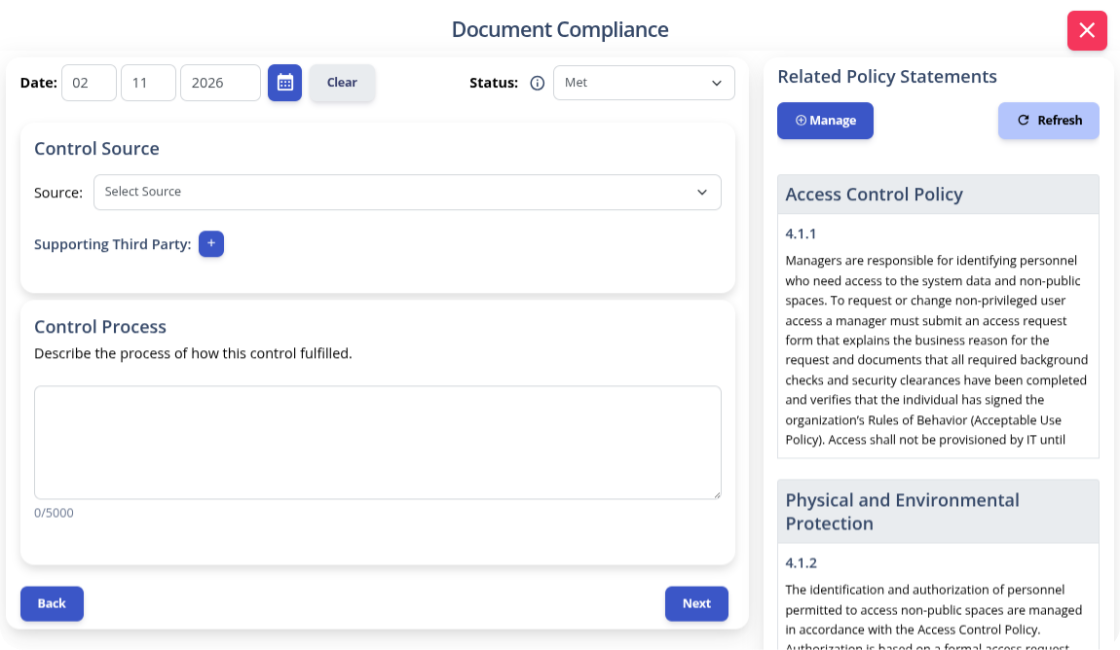
Write your policies before you start drafting your security plan. K2 GRC shows you exactly how each part of your policy connects to your security goals. This starts with selecting an objective to document.
After selecting a criteria, K2 GRC shows policy statements relevant to that criteria. The input screen shows the specific policy name and the statement’s number. This enables users to cite relevant policy sections within the control narratives. The system aggregates these control narratives to populate the system security plan (SSP).
It's terrifying that someone can bypass technical controls by accessing an unlocked room. You have worked too hard to let an unescorted visitor put your entire mission at risk.
You deserve the peace of mind that comes from knowing your physical space is as secure as your network. Having a Physical and Environmental Protection policy takes the guesswork out of security. You stop wondering who has a spare key.
Instead, you can create a culture of vigilance. A culture that protects your equipment, data, and reputation. Don't spend your time struggling to write CMMC policies from scratch. Download our pre-written and pre-mapped Physical and Environmental Protection Policy template today.
Give your team the roadmap they need to secure your facility. Secure your data’s home today so you can focus on growing your business tomorrow.
❓ Frequently Asked Questions About CMMC Physical and Environmental Protection Policy
What is a CMMC Physical and Environmental Protection policy?
A CMMC Physical and Environmental Protection policy defines how an organization protects physical spaces, systems, and equipment from unauthorized access or environmental risks. It helps document requirements for facility access, visitor control, monitoring, and secure areas.
What are CMMC PE controls?
CMMC PE controls focus on protecting physical facilities and restricting access to systems that process or store sensitive information. These controls may include visitor logs, escorts, access badges, locked rooms, cameras, alarms, and monitoring of physical access points.
Why is physical security important for CMMC compliance?
Physical security is important because technical controls cannot protect systems if someone can walk into a restricted area and access equipment directly. A CMMC Physical and Environmental Protection policy helps ensure your facility, devices, and sensitive data stay protected in the real world.
What should be included in a CMMC PE policy?
A CMMC PE policy should include the policy purpose, scope, governance details, physical access rules, visitor requirements, monitoring procedures, roles and responsibilities, related documents, and revision history. It should also connect policy statements to the relevant CMMC objectives.
How do visitor logs support CMMC physical security requirements?
Visitor logs help organizations track who entered non-public spaces, when they arrived, who escorted them, and when they left. This creates an audit trail that can support incident reviews and demonstrate that physical access is being monitored.
Do CMMC Level 2 organizations need a physical security policy?
Yes, organizations pursuing CMMC Level 2 should document how they manage physical access, monitor facilities, and protect systems from unauthorized entry. A CMMC Physical and Environmental Protection policy gives assessors a clear view of how these requirements are handled.
Can a CMMC PE policy template help with compliance?
Yes, a CMMC PE policy template can help reduce the time it takes to build a compliant policy from scratch. The best templates are already structured around CMMC objectives and can be customized to match your organization’s facility, roles, and access procedures.
Learn what a System Security Plan (SSP) includes, who needs one, and how organizations use SSPs to document security controls, support compliance efforts, and maintain audit readiness. Explore a real System Security Plan example and best practices for managing SSPs effectively.
Explore the key components of a CMMC System and Information Integrity policy, including flaw remediation, malware protection, system monitoring, and SSP alignment.
Learn how healthcare organizations can identify, evaluate, and mitigate clinical, operational, cybersecurity, and compliance risks to improve patient safety, strengthen resilience, and support long-term success.*


.png)