HIPAA Physical Safeguards: What's New and How to Prepare

Oct 16, 2026
The proposed HIPAA Security Rule requires written policies and 12-month reviews. Use our 2013-to-2027 crosswalk to find gaps in your physical safeguards.
Read More
10 min Read

The average cost of a data breach reached $4.88 million. That’s a 10% increase from the previous year and the largest jump since the pandemic. Researchers found that operational disruption, lost business, and post-breach recovery efforts were major contributors to those rising costs.
For organizations, this highlights an important reality: preventing every attack is no longer a realistic goal. Cyber threats continue to evolve, attackers continue to find new opportunities, and even mature security programs can experience a breach. A single ransomware attack, compromised account, or overlooked vulnerability can disrupt business operations and create lasting financial consequences.
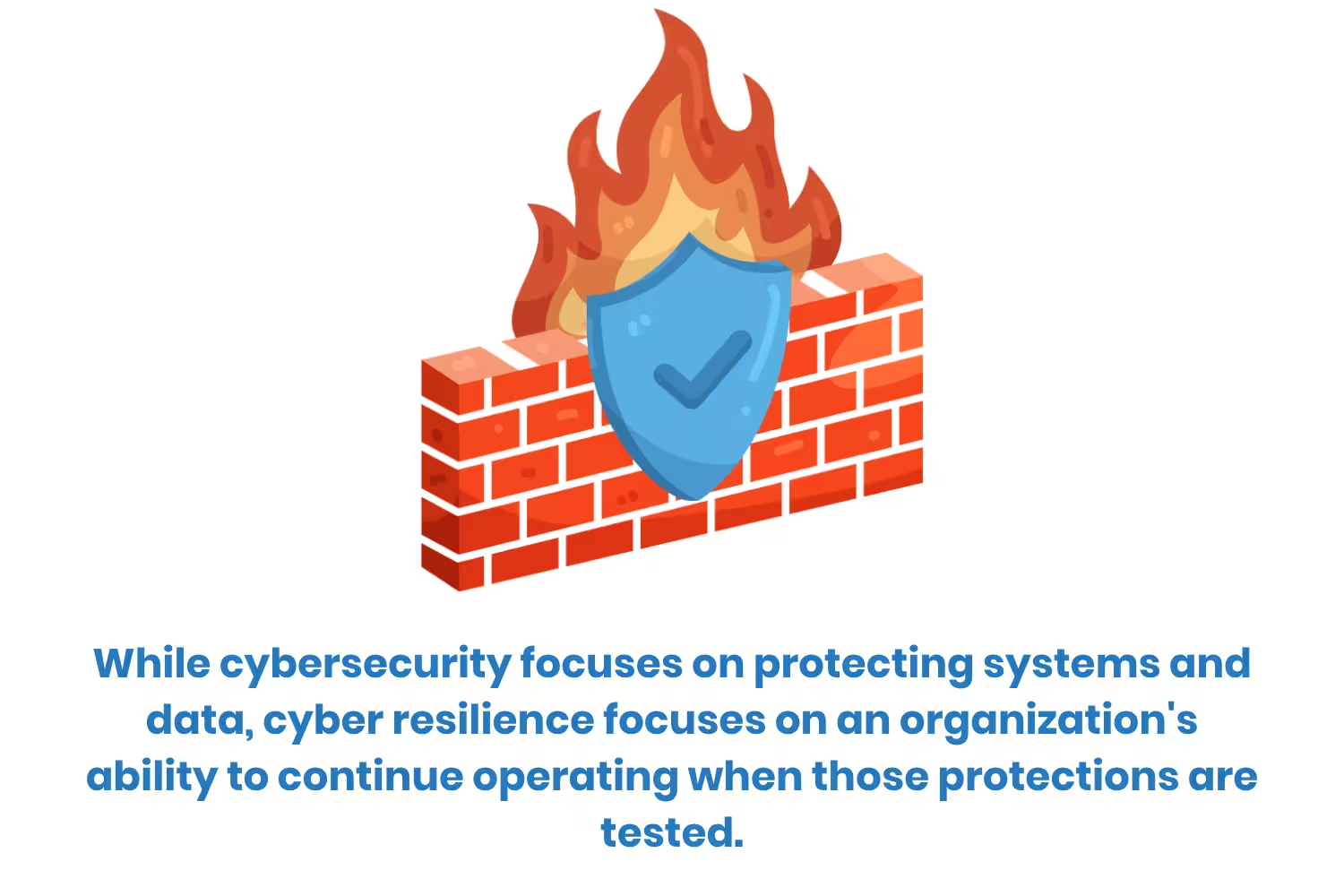
This shift in the threat landscape has increased interest in cyber resilience. While cybersecurity focuses on protecting systems and data, this broader approach focuses on an organization's ability to continue operating when those protections are tested. It provides a framework for responding to cyber incidents, limiting disruption, and recovering as efficiently as possible.
Understanding the relationship between cyber resilience and cybersecurity can help organizations strengthen their security posture and prepare for future challenges.
Cyber resilience is the ability to anticipate, withstand, respond to, and recover from cyber threats while maintaining critical business operations. Instead of assuming every attack can be prevented, it recognizes that incidents will happen and focuses on limiting their impact.
At its core, this capability is about an organization's ability to continue functioning during adverse conditions. Whether the issue stems from a ransomware attack, a data breach, human error, or another form of disruption, the goal remains the same: maintain operations and restore affected systems as quickly as possible.
Building this kind of resilience requires more than deploying security tools. Organizations need documented processes, defined responsibilities, recovery procedures, and leadership support. They also need a clear understanding of which systems are essential to daily operations and what steps should be taken when those systems become unavailable.
Cyber resilience isn't a replacement for cybersecurity. Instead, it expands on traditional security practices by addressing what happens after a successful attack. An effective plan helps organizations prepare for incidents before they occur and establish recovery processes that reduce downtime when disruptions happen.
As cyber risks continue to grow, organizations are recognizing that cyber resilience is critical for long-term operational stability. The ability to recover from cyber threats has become just as important as the ability to prevent them.
The discussion around cyber resilience vs. cybersecurity often creates confusion because the two concepts are closely connected.
Cybersecurity focuses on protecting networks, applications, devices, and sensitive data from unauthorized access or malicious activity. Organizations invest in security controls, threat detection technologies, monitoring platforms, and other security measures to reduce risk and prevent cyberattacks.
Cyber resilience approaches the challenge from a different perspective. Rather than concentrating exclusively on prevention, it focuses on how an organization responds when prevention efforts fail.
For example, a cybersecurity program may stop thousands of malicious attempts from reaching critical systems. However, if an attacker successfully compromises an account or exploits a vulnerability, cyber resilience determines how effectively the organization can contain the incident, maintain operations, and recover.
Cybersecurity focuses on protecting assets. A resilient organization ensures those assets can continue supporting business operations during and after a cyber event.
This distinction matters because no security program is perfect. Organizations face evolving cyber threats every day, and new attack methods constantly emerge. Having this kind of operational resilience makes it possible to continue serving customers, supporting employees, and protecting critical services even when disruptions occur.
Organizations that combine strong cybersecurity practices with effective cyber resiliency are often better positioned to withstand attacks and recover from cyberattacks with less operational impact.
The components of cyber resilience work together to support both preparedness and recovery. While every organization has unique requirements, several core areas form the foundation of an effective framework.
Effective cyber risk management starts with understanding what needs protection.
Organizations should identify critical systems, evaluate vulnerabilities, and assess how cyber risks could affect business operations. This process helps security teams understand where resources should be focused and which assets would have the greatest impact if compromised.
Risk management also provides insight into the organization's attack surface. As new technologies, applications, and third-party relationships are introduced, new risks often emerge. Regular assessments help organizations adapt to cyber threats and maintain a stronger security posture over time.
Platforms like K2 GRC help organizations centralize this process, connecting governance and compliance data to quantitative financial risk insights so leadership can prioritize investments based on actual exposure. We’ve completely eliminated subjective scoring from the equation. Learn more about K2 GRC’s Risk feature.
Every organization should have a documented incident response process.
When cyber incidents occur, response teams need clear guidance on containment, investigation, communication, and remediation activities. Without a plan, organizations often lose valuable time trying to determine next steps while an incident continues to unfold.
An incident response plan establishes responsibilities before an emergency occurs. It helps security teams coordinate activities, communicate effectively, and respond to threats with greater confidence.
Strong incident response capabilities can significantly reduce the impact of a breach and improve overall recovery outcomes.
Business continuity and disaster recovery are essential elements of a cyber resilience plan.
Business continuity focuses on maintaining operations during a disruption. Disaster recovery focuses on restoring systems, applications, and data after an incident occurs.
Together, these capabilities help organizations continue delivering services when critical systems are unavailable. Recovery strategies should be aligned with business priorities so that the most important functions receive attention first.
Organizations that regularly test backup systems and recovery procedures are often able to quickly recover while minimizing downtime and operational disruption.
Organizations need visibility into their environments to identify potential threats before they become major incidents.
Threat detection capabilities help security teams recognize unusual behavior, investigate suspicious activity, and take action before problems spread. Modern security tools often use automation to improve monitoring efforts and accelerate response activities.
Automation can help organizations identify issues faster and reduce the workload placed on security teams. When combined with proactive security measures, continuous monitoring supports a more resilient security program.
K2 GRC's Phishing Simulation and Dark Monitoring service takes this further with automated phishing simulations and real-time dark web monitoring, giving organizations continuous visibility into workforce vulnerabilities before attackers can exploit them.
Building cyber resilience requires a combination of planning, technology, and ongoing improvement.
Data protection remains one of the most important cyber resilience strategies organizations can implement.
Encryption, access controls, secure backups, and retention policies help safeguard sensitive data and reduce the impact of a potential data breach. Strong data security practices also support regulatory compliance efforts and improve overall resilience.
When critical information is protected and recoverable, organizations can recover from cyberattacks more effectively.
The earlier a breach is identified, the easier it is to contain.
Organizations should regularly evaluate their threat detection capabilities and incident response procedures. Improving visibility across the environment helps security teams identify threats sooner and reduce the likelihood of widespread disruption.
Faster detection often leads to faster response and recovery, which can reduce costs and minimize operational impact.
A cyber resilience plan should never remain static.
Technology environments change, business priorities evolve, and new cyber threats emerge every year. Organizations should routinely review recovery processes, conduct exercises, and test backup systems to ensure plans remain effective.
K2 GRC supports this process through integrated policy management and compliance training tools that help teams stay aligned as requirements evolve. Explore K2 GRC’s eLearning service for workforce training built around compliance.
Many organizations also perform a cyber resilience review to identify gaps and validate existing procedures. These reviews can reveal weaknesses that might otherwise go unnoticed until a real incident occurs.
Regular testing helps organizations maintain confidence in their recovery strategies and improve preparedness for future cyber events.
The benefits of cyber resilience extend far beyond security.
Organizations with effective programs in place are often better prepared to maintain operations during disruptions and recover from cyber threats with less business impact. This ability becomes increasingly valuable as attacks become more sophisticated and more costly.
The approach helps reduce downtime, improve recovery time, and support business continuity objectives. It can also help organizations mitigate reputational damage by demonstrating preparedness and operational stability during a crisis.
A cyber resilient organization is often able to respond more effectively when incidents occur because recovery processes have already been established and tested. Teams understand their responsibilities, leadership has visibility into response efforts, and critical systems can be restored more efficiently.
This adaptability also strengthens confidence among customers, partners, and stakeholders who depend on reliable services.
Most importantly, the ability to withstand and recover from attacks makes it possible to continue supporting critical business functions even when systems are affected. That capability has become increasingly important as organizations face a growing number of cyber risks.
The Cyber Resilience Act is a European Union regulation designed to improve the security of digital products throughout their lifecycle.
The resilience act places greater emphasis on vulnerability management, secure software development practices, and ongoing security maintenance. Organizations that develop or provide digital products may need to demonstrate that security has been incorporated into product design and support processes.
Although the regulation is focused on the European market, its principles align with broader cybersecurity standards and industry best practices. Many organizations are using these requirements as an opportunity to strengthen their overall security posture and preparedness.
As regulatory expectations continue to evolve, organizations that prioritize cyber resilience are often better positioned to adapt to new requirements while maintaining effective security programs. For organizations navigating complex frameworks like CMMC, K2 GRC provides the tools to manage certification and stay audit-ready.
Cyber resilience is the ability to prepare for, withstand, and recover from cyber threats while maintaining critical business operations. As cyberattacks become more frequent and more disruptive, organizations need more than preventive security measures alone.
A strong strategy combines cybersecurity, risk management, incident response, business continuity, disaster recovery, and recovery planning into a unified approach. Thus, having the right platform to manage those moving parts makes all the difference.
K2 GRC brings these capabilities together in one place, helping organizations quantify risk, maintain compliance, train their workforce, and stay audit-ready as the threat landscape evolves. Building this kind of resilience is not a one-time initiative, and K2 GRC is built for exactly that kind of ongoing commitment.