🇪🇺 Demystifying the EU AI Act: Compliance, Risk Tiers, and Governance

According to IBM's 2025 Cost of a Data Breach Report, 13% of organizations reported breaches of AI models or applications, and 97% of those breached lacked proper AI access controls. The EU Artificial Intelligence Act is the world's first comprehensive legal framework designed to close this exact oversight gap. By categorizing AI into risk tiers and establishing strict oversight, transparency, and safety rules, the EU AI Act ensures that AI innovation doesn't outpace safety. If your organization builds, sells, or uses AI that impacts EU residents, compliance is mandatory—even if your business is based in the United States.

Core Components of the EU AI Act

  • ⚠️ The Risk-Based Approach: The Act classifies AI into four tiers: Unacceptable risk (banned outright), High-risk (allowed but strictly regulated), Limited risk (transparency requirements, like labeling chatbots), and Minimal risk (no extra rules).
  • 🚫 Banned "Unacceptable" Practices: Nine AI practices are strictly prohibited because they present too much risk. These include social scoring, scraping the internet for facial recognition databases, reading emotions in the workplace, and generating non-consensual deepfakes (a rule finalized in the AI Omnibus).
  • 📋 High-Risk Compliance Requirements: High-risk systems—such as AI used in hiring, credit scoring, education, or healthcare—must undergo rigorous data quality checks, implement activity logging, ensure robust cybersecurity, and require human oversight.
  • 🤖 General-Purpose AI (GPAI): Large foundational models that power generative AI must adhere to strict transparency rules, publish training data summaries, and respect EU copyright laws. GPAI models carrying "systemic risk" face deeper testing and incident reporting overseen by the newly formed EU AI Office.
  • 📅 Implementation Timeline: The law entered into force in August 2024 and phases in gradually. Banned practices and AI literacy rules took effect in February 2025. Transparency and high-risk AI rules activate in August 2026, while compliance for sensitive high-risk systems is pushed to December 2027 and regulated products to August 2028.

According to IBM's 2025 Cost of a Data Breach Report, 13% of organizations reported breaches of AI models or applications. 97% of those breached had no proper AI access controls in place. That gap between fast AI adoption and slow AI oversight is exactly the problem regulators in Europe set out to fix.

The EU AI Act is the answer: a sweeping law meant to force real governance around artificial intelligence before weak controls turn into costly breaches, fines, or worse. Whether you're building AI tools or simply using them, understanding EU AI Act compliance is quickly becoming a business necessity. Not a side project for the legal team.
What Is The EU Artificial Intelligence Act?

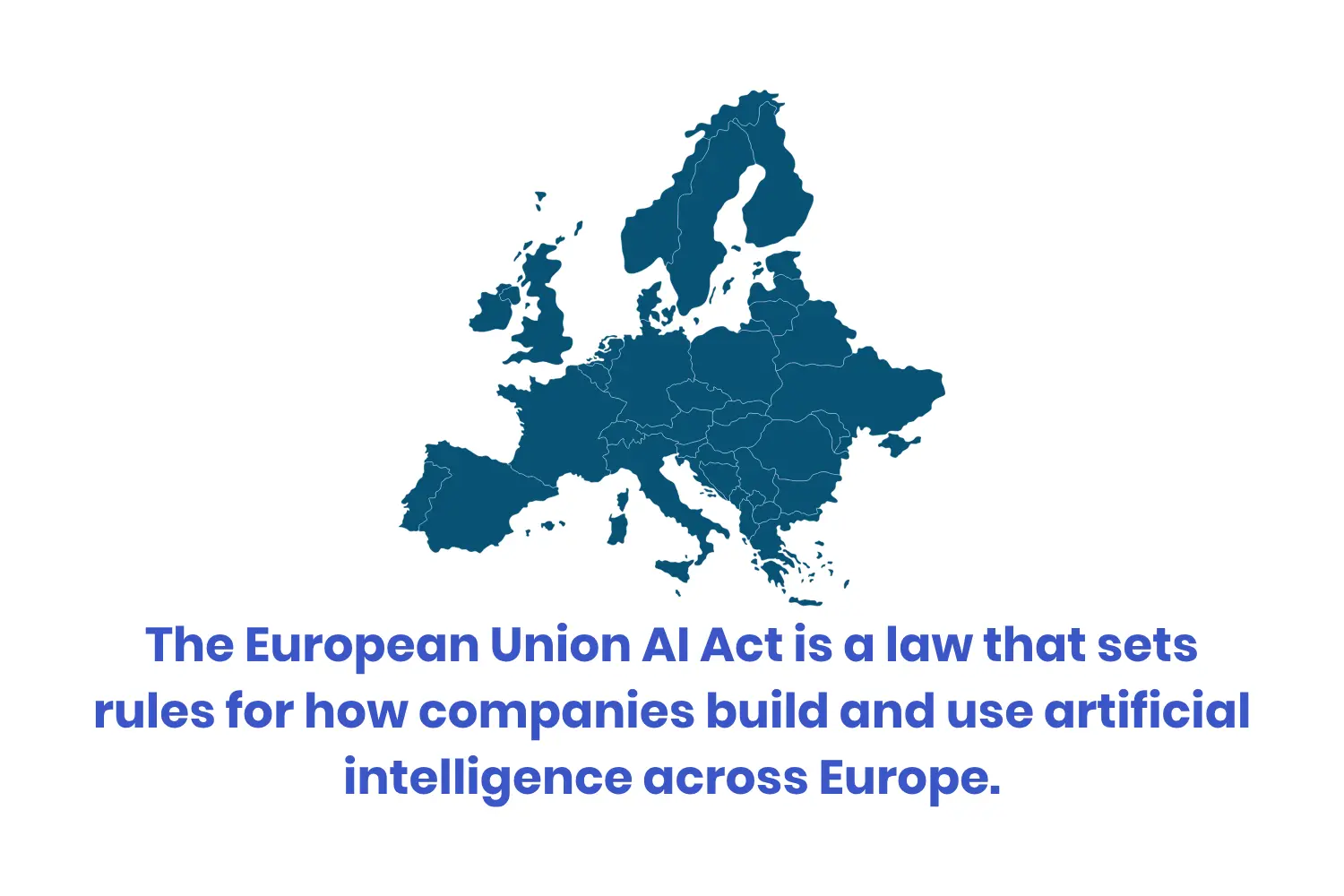
The European Union AI Act is a law that sets rules for how companies build and use artificial intelligence across Europe. You may be thinking, "I live in America, why should I care?" This applies to U.S. businesses, too. If your AI systems affect EU residents, you need to pay attention.

EU AI Act compliance means your business follows these rules for every AI system it builds, sells, or uses. Some call it the artificial intelligence act or AI regulation. No matter what you call it, the purpose stays the same.
It is the world's first rulebook of its kind. The act treats AI like a product that needs safety checks, much like cars or medicine. In fact, the act is the first comprehensive attempt anywhere to control how businesses build AI and how they use it at scale. The rules require AI systems to be safe, transparent, traceable, and fair, which is a lot to manage without a plan.

Who Does the EU AI Act Apply To?

The EU AI Act applies to almost anyone who builds, sells, or uses AI tools tied to the European Union, no matter where the company is based. If your AI use affects people inside the EU market, you likely fall under this law.
This includes:

  • Companies based in an EU member state that build or sell AI.
  • Foreign companies who sell their AI tools inside the EU.
  • Providers of GPAI, meaning companies that build large general AI models.
  • Businesses that simply use AI, even if they didn't build it.

Each EU member state has its own watchdog group to check on local companies. However, the rules are the same across the whole union. If your AI has a significant impact on the EU market, or plays a role in the AI value chain that reaches EU users, you are likely subject to the AI act. Both AI providers and deployers have duties under this law.

Understanding the EU AI Act's Risk-Based Approach

The EU AI Act does not treat every AI system the same way. Instead, it sorts AI into risk tiers based on how much harm it could cause. This risk-based approach shapes almost everything else in the law.

There are four main levels:

  1. Unacceptable risk - banned outright.
  2. High-risk - allowed, but with strict rules.
  3. Limited or transparency risk - must be clear with users. Such as letting people know they are interacting with an AI system like a chatbot.
  4. Minimal or no risk - little to no extra rules.

This tiered system lets the law focus its toughest risk management rules on the AI that could cause the most harm. While leaving low-risk tools like spam filters or AI-powered video games mostly alone; most AI systems present in the EU today actually fall into this lowest tier. The AI act imposes stronger duties as the risk level goes up, so a chatbot has fewer rules than a hiring tool, for example.

What AI Practices Are Unacceptable Risk?

Some AI practices are simply too risky to allow. The EU AI Act bans these outright, no matter who is using them or why. This is the strictest part of the law, and the AI Act prohibits nine specific practices:

  • Manipulating people in harmful ways they can't easily notice.
  • Exploiting a person's vulnerabilities, such as age or disability.
  • Social scoring, where a system rates people based on behavior.
  • Predicting the risk of someone committing a crime based only on personal traits.
  • Scraping the internet or CCTV footage to build facial recognition databases.
  • Reading emotions at work or in schools.
  • Sorting people into categories based on protected traits like race or religion.
  • Real-time facial recognition by police in public spaces, with narrow exceptions.
  • Generating non-consensual sexual images, deepfakes, or child abuse material.

Most of these bans took effect early in the law's rollout. If your AI system falls into any of these categories, there is no path to compliance. It simply can't be sold or used in the EU.

What Are High-Risk AI Systems?

Many AI systems used in daily business life count as high-risk under the law. This includes tools used in hiring, credit scoring, education, law enforcement, and healthcare. If your AI helps decide who gets a job, a loan, or medical care, it will likely fall into this category.

Common examples of high-risk AI systems include:

  • AI safety parts of critical infrastructure, like transport systems.
  • AI used in schools to score exams or decide who gets in.
  • AI built into safety components of products, like robot-assisted surgery.
  • AI tools for hiring, managing workers, or sorting job applications.
  • AI used to approve or deny loans and other essential services.
  • AI used for remote biometric identification or emotion recognition.
  • AI used in law enforcement, such as evaluating evidence.
  • AI used in migration, asylum, and border control decisions.
  • AI used to help courts or democratic processes.

The key test is what the system should do and who it affects. If a system could seriously affect someone's health, safety, or rights, it usually lands in the high-risk group. This means extra rules apply before it can be sold or used.

EU AI Act Requirements for High-Risk AI Systems

Once you label a system as high-risk, a long list of compliance requirements kicks in. These are some of the key obligations of the AI act, and they apply before the AI ever reaches the market.

Companies must:

  • Set up a full risk management system that checks for harm before and after launch.
  • Use good-quality data to reduce the risk of unfair or discriminatory results.
  • Keep logs of activity so results can be traced back and reviewed.
  • Keep clear, detailed documentation for authorities to check compliance.
  • Give deployers the information they need to use the system safely.
  • Add human oversight, so a person can step in if the AI makes a mistake.
  • Meet a high bar for robustness, cybersecurity, and accuracy.

These obligations intend to catch problems early. Once the system is on the market, that oversight doesn't stop. Authorities still handle oversight of AI systems through market surveillance. Deployers keep watching for problems. Providers run ongoing post-market monitoring. Companies must be ready to demonstrate compliance to regulators at any time.

Rules for General-Purpose AI Models

The rules for general-purpose AI models cover a newer kind of AI. These tools do many different jobs, not only one. These are known as GPAI models for short. Think of large chatbots and tools that power generative AI features across many apps.

Providers of GPAI models must:

  • Share technical details about how they built the model.
  • Provide documentation to companies who build on top of the model.
  • Publish a summary of the training data used, following an official template.
  • Follow EU copyright law, including opt-out requests from content owners.

To make this easier, regulators published guidelines on the scope of these duties along with a GPAI Code of Practice. This is a voluntary tool that spells out practical steps for meeting the rules on transparency, copyright, and safety. Some AI models that display significant capability get extra scrutiny. This is because a GPAI model used to build many other apps can spread its risks across the whole AI value chain.

How Does the EU AI Act Address Systemic Risk?

Systemic risk is a risk that comes from AI models so powerful or widely used that problems could spread across many industries at once. This act created special rules for this level of risk.
We treat a GPAI model as carrying systemic risk when it has a significant impact on the EU market or shows unusually high capability. Once flagged, providers face added duties, including:

  • Deeper safety testing before release.
  • Reporting serious incidents to regulators.
  • Extra cybersecurity protections.
  • Ongoing risk assessments as you update the model.

The AI office, a body set up inside the European Commission, watches over these top-tier models and holds real enforcement power. It can request documents, run evaluations, demand fixes, and issue fines.

It works alongside the AI board, made up of representatives from each member state, plus a Scientific Panel of independent experts. As well as an Advisory Forum that brings in industry and civil-society voices. Together, these groups are enforcing the AI act across the EU.

How AI Governance Supports EU AI Act Compliance

Good AI governance is the backbone of real compliance. Without it, following the EU AI Act becomes a scramble every time a new rule applies. Strong governance means having clear rules inside your company for how you build, check, and approve AI before it's used.

A useful way to think about this is through three pillars. Your AI should be robust, lawful, and ethical. Building AI governance around these three ideas covers most of what regulators actually check for.
In practice, this usually means:

  • Naming a person or team responsible for AI oversight.
  • Keeping a live map of every AI system in use, so you can assess risk system by system.
  • Reviewing new AI tools before they're adopted.
  • Setting up regular checks tied to the law's risk tiers.
  • Training staff on the safe use, capabilities, and limits of the AI tools they work with.

An AI regulatory framework built into daily operations makes it far easier to adapt as the law changes. Companies that treat AI governance as an ongoing habit, not a one-time project, tend to have an easier time when regulators come asking questions.

Key Steps Toward EU AI Act Compliance

Getting ready doesn't have to feel overwhelming. Breaking your compliance efforts into clear steps makes the process much easier to manage.

  1. Map your AI – List every AI system your company builds or uses.
  2. Classify risk – Sort each system into the law's risk tiers.
  3. Check for banned uses – Rule out anything that touches unacceptable risk.
  4. Build documentation – Create records showing how each system works.
  5. Set up oversight – Add human review for high-risk tools.
  6. Train your team – Make sure staff understand how to comply with the ai act.
  7. Monitor and update – Review systems regularly as rules or models change.

Following these steps supports steady AI act implementation inside your organization, rather than a last-minute rush before a deadline. Voluntary efforts help too. The Commission's AI Pact invites companies to sign up early and commit to key parts of the law ahead of their legal deadlines, which is a low-risk way to get a head start.

How Organizations Can Prepare for the Implementation of the AI Act

The implementation of the AI act happens in stages, not all at once. Knowing the timeline helps you plan ahead instead of reacting under pressure.

The law entered into force in August 2024, but rules turned on gradually:

  • Banned practices and AI literacy rules started first, in February 2025.
  • Governance rules and rules for general-purpose AI models followed in August 2025.
  • Transparency duties, such as labeling AI-generated content, and most high-risk AI systems rules will happen in August 2026.

The deadline for high-risk systems used in sensitive areas like hiring, education, and biometrics will push to December 2027. High-risk AI built into already-regulated products, like machinery or toys, now has until August 2028.

The AI omnibus also extended simplified paperwork to more small and mid-sized companies and added more regulatory sandboxes where businesses can test AI solutions in real conditions.

Because the compliance deadline for high-risk systems has moved, it's smart to use the extra time wisely rather than waiting until the last minute. The act specifies different start dates for different obligations. AI developers and AI users should track which rules apply to their specific systems.

The act takes a phased approach on purpose, similar in spirit to how the EU's general data protection regulation rolled out years earlier. Preparing early also protects AI innovation, since companies that plan ahead can keep building without hitting sudden compliance walls.

How K2 GRC Can Support EU AI Act Compliance

Staying on top of the EU AI Act is easier with the right partner. K2 GRC helps organizations build practical AI governance programs that match each risk tier under the law, so nothing falls through the cracks.

K2 GRC can help your team:

  • Map and classify every AI system in use.
  • Build risk management processes that meet and keep up with compliance requirements.
  • Track changing deadlines tied to the AI omnibus and other updates.
  • Prepare documentation to demonstrate compliance if regulators ask.
  • Choose AI solutions that fit your risk profile from the start.

Whether you're just starting to explore regulatory compliance or refining an existing program, K2 GRC offers hands-on support compliance work that keeps your AI programs steady. Even as the rules around AI compliance keep evolving.


❓ EU AI Act & Compliance FAQ

Does the EU AI Act apply to companies based in the United States?

Yes. The EU AI Act operates on an extraterritorial basis. It applies to any organization—regardless of where its headquarters are located—that builds, sells, or deploys AI tools that impact individuals inside the European Union market.

What AI practices are considered "unacceptable risk" and banned?

The law outright bans nine specific AI practices. This includes social scoring, exploiting personal vulnerabilities, emotion reading in schools or workplaces, predictive policing based on personal traits, scraping the internet for facial recognition, and generating non-consensual sexual deepfakes.

What are the compliance requirements for "high-risk" AI systems?

High-risk AI systems (like those used for hiring, border control, or medical triage) must establish full risk management systems, ensure high-quality training data to prevent discrimination, maintain detailed technical documentation, log activity, provide robust cybersecurity, and incorporate mandatory human oversight.

When are the deadlines for EU AI Act compliance?

The law rolls out in stages. Banned practices became enforceable in February 2025, and GPAI rules took effect in August 2025. The core transparency and high-risk system obligations activate in August 2026, while deadlines for sensitive high-risk applications and regulated product AI stretch to December 2027 and August 2028, respectively.

Related Posts

EU AI Act Compliance: Everything You Need to Know

Sep 4, 2026
The EU AI Act is reshaping how businesses build and use AI. Learn what the law requires, who it applies to, and how to prepare your organization for compliance.
Read More
10 min read

Cyber Resilience: What It Is and Why It Matters

Sep 4, 2026
Learn what cyber resilience is, how it differs from cybersecurity, and why organizations need both to survive and recover from modern cyber threats.
Read More
10 min read

Third Party Risk Assessment Questionnaire: A Practical Guide

Sep 1, 2026
Learn how a third party risk assessment questionnaire helps organizations evaluate vendor security, meet compliance requirements, and reduce third-party risk.
Read More
10 min Read

Start your GRC journey today

Discover how K2 GRC can simplify compliance and enhance your organization's governance and risk management.