This blog explains how enterprise risk management (ERM) helps organizations identify risks, reduce potential harm, and make informed business decisions. It covers common risk categories, ERM frameworks, implementation steps, and best practices for building a proactive risk management program.
Key Takeaways
✅ Establish clear responsibilities and assess risks based on their likelihood and potential impact.
✅ Use an enterprise risk management framework to connect risk management with business goals and coordinate efforts across departments.
✅ Monitor risks regularly and use GRC software to organize documentation, track mitigation plans, and improve visibility into organizational risks.
Who Should Read This?
This guide is ideal for business leaders, risk managers, IT teams, and compliance professionals who want to improve how their organizations manage risk. It is especially useful for teams looking to move away from disconnected processes and build a more coordinated approach to identifying and addressing potential threats.
Organizations face internal and external risks that can disrupt operations, affect financial performance, and threaten strategic objectives. From cybersecurity threats to third-party vulnerabilities, these challenges require a coordinated approach to identify and manage risks before they escalate.
Enterprise risk management (ERM) helps organizations understand their risk exposure and make informed decisions across departments. An effective enterprise risk management program connects risk assessment, governance, and risk mitigation to the organization's broader goals.
Understanding what enterprise risk management is, how an ERM framework works, and how to implement one can help businesses build resilience and prepare for emerging risks.
What Is Enterprise Risk Management?
Enterprise risk management is a structured approach to identifying, assessing, prioritizing, and responding to risks across an organization. While traditional risk management strategies may focus on individual threats or departments, ERM creates a coordinated approach to managing risks across the entire organization.
For example, a cybersecurity breach could create operational disruptions, financial losses, compliance concerns, and damage to a company's reputation. A holistic approach helps organizations understand these connections and coordinate their response.
An ERM program typically considers strategic, financial, operational, cybersecurity, and compliance risks. It also establishes accountability for managing those risks and communicating important changes to decision-makers.
The goal is not to eliminate every risk. Instead, enterprise risk management helps organizations make informed decisions about which risks to accept, mitigate, transfer, or avoid while pursuing their strategic objectives.
Enterprise Risk Management vs. Traditional Risk Management
Although enterprise risk management and traditional risk management share similar objectives, they differ in how organizations identify, evaluate, and manage potential threats.
Traditional risk management often focuses on specific risks within individual departments or business functions. Enterprise risk management takes a broader approach by evaluating how risks are interconnected and how they could affect the organization's overall strategic objectives.
Traditional risk management compared with enterprise risk management
Considers both threats and strategic opportunities
May emphasize reactive responses
Encourages proactive risk assessment and monitoring
Reports risks within individual teams
Provides leadership with a consolidated view of risk exposure
Both approaches play an important role in protecting an organization. ERM builds on traditional risk management practices by connecting individual activities to broader business objectives and leadership decision-making.
What Is an ERM Framework?
An ERM framework establishes the structure, responsibilities, and risk management processes an organization follows to manage risk. It defines how teams identify key risks, conduct assessments, implement controls, and report findings to leadership.
The COSO framework connects risk management with governance, strategy, and performance. Its five components are governance and culture, strategy and objective-setting, performance, review and revision, and information, communication, and reporting.
ISO 31000:2018 provides broader guidelines for establishing and improving risk management practices across different industries and organizational structures.
Organizations can use these frameworks to develop a consistent approach that reflects their business objectives, risk factors, and operating environment. The right approach depends on the organization's size, industry, existing controls, and risk exposure.
Key Risks an Enterprise Risk Management Program Should Address
An enterprise risk management program should account for the risks most likely to affect an organization's objectives. Although specific exposures vary by industry, several categories commonly require attention.
Strategic risks involve decisions that affect long-term business performance, such as entering new markets or changing business models. Financial risks include cash flow challenges, credit exposure, and unexpected expenses. Operational risk involves failures in processes, staffing, technology, or service delivery.
Cyber risk is another critical consideration. Cybersecurity incidents, data breaches, and unauthorized access can disrupt business operations and expose sensitive information. Third-party risks also deserve attention because vendors and business partners may introduce vulnerabilities into an organization's systems or processes.
Compliance risks arise when an organization fails to meet applicable laws, regulations, contractual requirements, or internal policies. In the U.S., certain industries, including financial institutions and publicly traded companies, face specific regulatory and reporting obligations. Non-compliance can result in penalties, increased scrutiny from a regulator, and reputational damage.
For example, the U.S. Department of Health and Human Services (HHS) has proposed updates to the HIPAA Security Rule that would strengthen requirements for cybersecurity risk analysis, documented risk management plans, and ongoing security oversight. Although these changes have not been finalized, they illustrate how regulatory expectations can reinforce the importance of structured risk management processes, clear accountability, and continuous monitoring. Healthcare organizations can use K2 GRC's HIPAA Security Rule Crosswalk 2013 to 2027 to compare existing requirements with the proposed updates and identify potential compliance gaps.
These risks often overlap. A single incident can affect several departments, making it essential to evaluate how individual threats connect to the organization's broader risk profile.
Enterprise Risk Management Example
Consider a healthcare organization preparing to implement a new electronic health record (EHR) system. While the implementation may improve operational efficiency, it also introduces risks across multiple areas of the business.
From an enterprise risk management perspective, the organization would evaluate several interconnected risks:
Cybersecurity Risk: Unauthorized access or a data breach could compromise sensitive patient information.
Operational Risk: System downtime or implementation challenges could disrupt patient care and daily operations.
Financial Risk: Unexpected implementation costs, recovery expenses, or operational interruptions could affect financial performance.
Compliance Risk: Failure to meet applicable HIPAA requirements could result in regulatory consequences.
Rather than allowing each department to evaluate these risks independently, an ERM program brings stakeholders together to assess their potential impact on the organization's broader objectives.
Leadership can then prioritize risks, assign ownership, establish mitigation plans, and monitor progress through a centralized risk management process.
This coordinated approach helps organizations make more informed decisions while understanding how individual risks may affect the entire business.
How to Implement an Effective ERM Program
To implement an effective ERM program, organizations need a repeatable process for identifying risks, evaluating their potential impact, assigning responsibility, and monitoring results.
The process should reflect the organization's strategic objectives and remain flexible enough to evolve as conditions change.
1. Establish Governance and Risk Oversight
Effective enterprise risk management begins with clear governance. Leadership must determine who oversees the program, who manages individual risks, and how risk-related decisions are made.
Board-level oversight may be appropriate for significant risks, particularly when they could affect financial stability, strategic direction, or compliance obligations. Management's responsibilities include setting expectations, allocating resources, and ensuring that risk management activities support business priorities.
A clearly defined ERM function helps coordinate these responsibilities and encourages accountability across the organization.
2. Identify and Assess Key Risks
A risk assessment helps organizations evaluate the likelihood of a potential event and the severity of its consequences. Teams can identify risks through internal audits, interviews, incident reports, vendor reviews, cybersecurity assessments, and operational evaluations.
Once risks are documented, the management team can assess their potential impact on finances, operations, compliance, and reputation. Consistent assessment criteria make it easier to compare risks across departments and determine which require immediate attention.
A centralized risk register can support this process by recording risk descriptions, existing controls, assigned owners, and planned responses. Reviewing practical risk register examples can help organizations understand how to structure risk documentation across different departments.
Free Download: FAIR-Based Risk Register Template
Take the next step in building your enterprise risk management program with our free FAIR-Based Risk Register Template. Identify and document cybersecurity risks, evaluate potential financial exposure, and prioritize mitigation efforts using a structured, repeatable approach.
3. Prioritize Risks and Develop Mitigation Strategies
After assessing risk exposure, organizations need to determine which issues require the most attention. Prioritization should consider potential business impact, likelihood, existing safeguards, and the organization's risk appetite.
Organizations can also use quantitative risk analysis to estimate the potential financial impact of cybersecurity risks and prioritize mitigation efforts based on measurable business exposure.
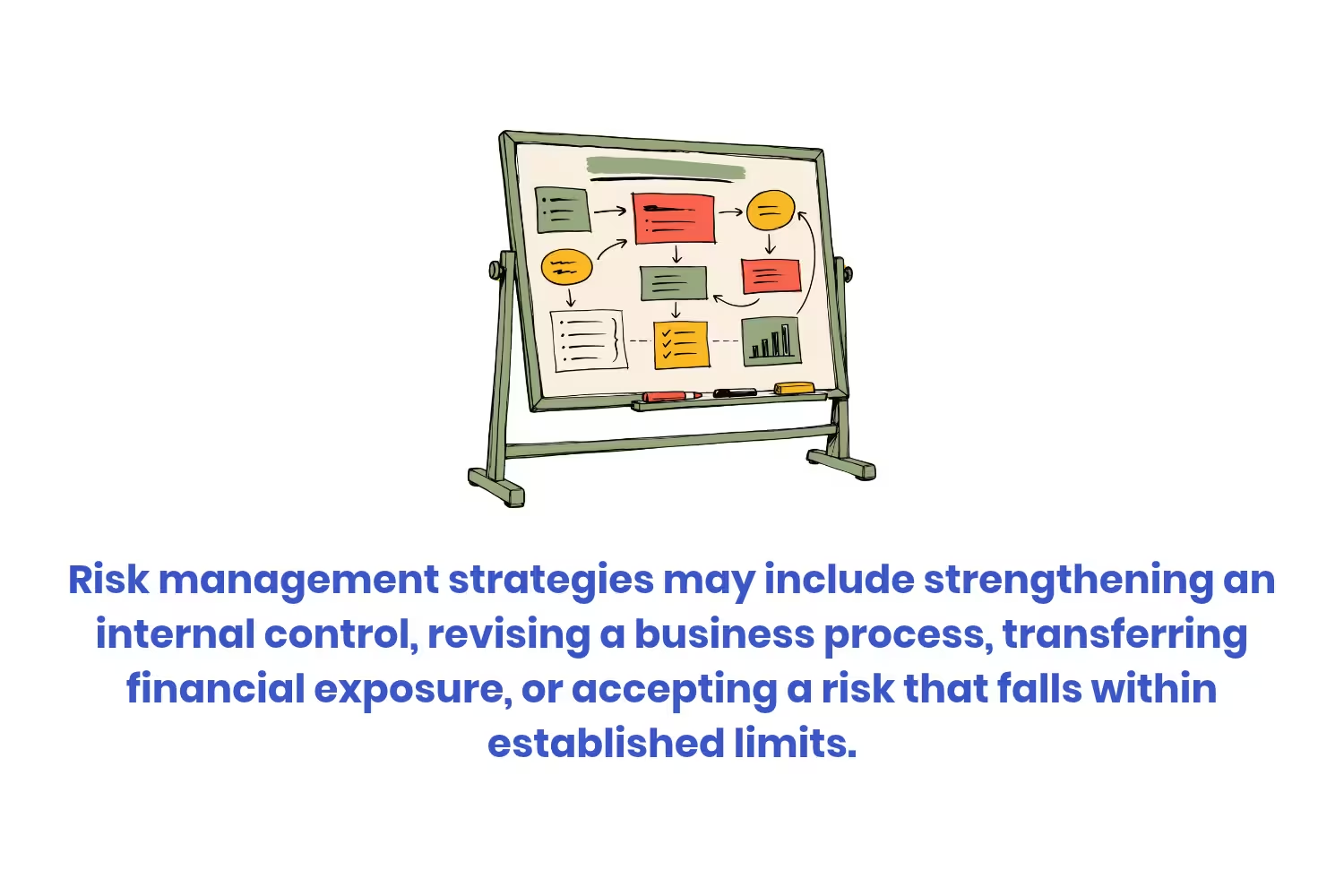
Risk management strategies may include strengthening an internal control, revising a business process, transferring financial exposure, or accepting a risk that falls within established limits.
Assigning an owner to each significant risk helps ensure that mitigation activities have clear responsibilities and deadlines. Regular reporting also allows leadership to determine whether risk responses are working as intended.
4. Integrate Risk Management Across the Organization
ERM is most effective when risk management processes are integrated into everyday business activities. Human resources, IT, finance, operations, and compliance teams should understand how their responsibilities contribute to the organization's overall risk position.
A proactive approach encourages teams to consider risk before making significant decisions, rather than responding only after a problem occurs. It also helps reduce siloed efforts that can leave important risks overlooked.
5. Monitor, Report, and Improve
Risks change as organizations adopt new technologies, enter partnerships, expand operations, and encounter new regulatory requirements. Ongoing monitoring helps organizations recognize these shifts and update their response plans.
Risk reports, control reviews, incident tracking, and key risk indicators can provide insight into changing conditions. Where available, real-time reporting can improve visibility into developing issues and outstanding mitigation activities.
Regular reviews help organizations evaluate whether their ERM program remains effective and where improvements are needed.
Effective Enterprise Risk Management Best Practices
Effective enterprise risk management requires more than documenting threats. Organizations need consistent processes, clear accountability, and a risk-aware culture that encourages communication.
One of the most important best practices is to connect risk management with strategic planning. Leadership should consider potential risks when approving investments, evaluating new vendors, adopting technology, and setting organizational priorities. This approach aligns with NIST's guidance on enterprise risk management, which emphasizes evaluating risks from an organization-wide perspective rather than treating them as isolated issues.
Organizations should also establish consistent assessment criteria. When departments use different methods to evaluate risk, leadership may struggle to compare exposures or determine where resources are most needed.
Another essential practice is to maintain clear documentation. Risk registers, control records, assessment results, and mitigation plans help stakeholders understand current responsibilities and outstanding issues.
Regular communication is equally important. Employees should know how to report potential concerns, while leadership needs accurate information about critical risks and significant changes. This supports a proactive culture instead of a reactive response to preventable problems.
Finally, organizations should review their risk management frameworks regularly. A strategic ERM program must evolve alongside the business, accounting for new technologies, third-party relationships, emerging risks, and changes in compliance obligations.
Conclusion
Enterprise risk management helps organizations identify potential threats, assess risk exposure, and make informed decisions that support their strategic objectives. By establishing clear governance, consistent risk assessment processes, and ongoing monitoring, organizations can better manage uncertainty and strengthen resilience.
As risks evolve, organizations need a proactive approach that connects risk management across departments. GRC software can support these efforts by centralizing documentation, tracking mitigation activities, and improving visibility into organizational risks.
K2 GRC provides a centralized risk management platform that helps organizations quantify cyber risk, coordinate mitigation activities, and improve visibility into potential financial exposure. With the right framework, processes, and technology, organizations can build a more effective ERM program and better prepare for emerging risks.
❓ Frequently Asked Questions About Enterprise Risk Management (ERM)
1. What is enterprise risk management (ERM)?
Enterprise risk management (ERM) is a structured approach to identifying, assessing, prioritizing, and responding to risks across an organization. It helps leadership understand potential threats to business objectives and coordinate risk management efforts across departments.
2. What are the five steps of enterprise risk management?
The five key steps of enterprise risk management are establishing governance, identifying and assessing risks, prioritizing risks and developing mitigation strategies, integrating risk management across the organization, and monitoring results. These steps create a repeatable process for managing risk and adapting to changing business conditions.
3. What is an enterprise risk management framework?
An enterprise risk management framework defines the structure, responsibilities, and processes an organization uses to manage risk. It guides teams in identifying threats, assessing their potential impact, implementing controls, and reporting findings to leadership. COSO ERM and ISO 31000 are two widely recognized risk management frameworks.
4. What are the main types of enterprise risk?
The main types of enterprise risk include strategic, financial, operational, cybersecurity, third-party, and compliance risks. These risks can overlap, meaning a single incident may affect finances, daily operations, customer trust, and business reputation. An effective ERM program evaluates how these risks influence the organization's overall objectives.
5. What is the difference between COSO ERM and ISO 31000?
COSO ERM emphasizes integrating risk management with governance, strategy, and organizational performance. ISO 31000 provides broader guidelines for establishing and improving risk management practices across different industries and organizational structures. Organizations should choose an approach that aligns with
Learn what enterprise risk management (ERM) is, how it works, and why it matters. Explore common risk categories, ERM frameworks, key benefits, and best practices for identifying, assessing, and mitigating organizational risks.
Compare LMS pricing models, typical costs by company size, and hidden fees. Learn how to calculate total cost of ownership before you choose a platform.