☁️ Mastering FedRAMP: A Guide for Secure Cloud Adoption
With nearly 80% of organizations facing cloud security incidents in the past year, the Federal Risk and Authorization Management Program (FedRAMP) is the gold standard for protecting government data in the cloud. It replaces duplicative agency audits with a "do once, use many times" approach to security.
Key Takeaways
✅ Impact Levels: FedRAMP categorizes data into Low (150+ controls), Moderate (320+ controls), and High (400+ controls) impact levels based on FIPS 199.
✅ 6-Step Authorization: A structured path from categorization and control implementation to independent assessment and continuous monitoring.
✅ Training is Critical: Navigating the 12-18 month certification process requires comprehensive awareness training for project managers, engineers, and compliance leads.
✅ Efficiency: Integration of self-paced learning (like K2 Akademy) directly into GRC workflows reduces audit preparation stress and automates evidence collection.
Who is this for?
Cloud Service Providers (CSPs) looking to work with federal agencies and compliance officers tasked with navigating the GSA’s rigorous
More than 60% of organizations faced cloud-related security incidents in 2024. In the past year, nearly 80% of organizations reported the same. It's safe to say that this problem is obviously not going away. But only becoming more common as technology continues to advance. With more businesses moving sensitive data to cloud services, requirements become stricter.
Investing in training to keep your company safe from cyber attacks is no longer optional... it's expected. Not only from stakeholders, but government agencies as well. Especially when it comes to particular kinds of sensitive information.
Today, we will dive into how to keep federal information safe from prying eyes. Specifically, while moving it to a cloud service. We are talking about the Federal Risk and Authorization Management Program (FedRAMP).
The mission of FedRAMP is to protect federal information stored, processed, or shared in cloud products. Ran by the General Services Administration (GSA), this provides a framework for secure cloud adoption. Helping to ensure FedRAMP compliance.
It can feel overwhelming when it comes to meeting FedRAMP standards. Whether you work for a Cloud Service Provider (CSP) or government agency. Never fear, because we know that comprehensive training is the most valuable tool in your journey towards FedRAMP certification. This guide explores the "what, why, and how" of FedRAMP training. K2 GRC is here to help you navigate the complexities of the certification process.
What is FedRAMP?
I went over the basics a little bit. Let's further dissect the question of "what is FedRAMP" so there's no confusion. This program is a government-wide initiative. This framework provides a simple, risk-based approach for the use of cloud services. Before FedRAMP, federal agencies had to conduct the same security assessments repeatedly. Wasting time, the tax payers money, and resources.
What do I mean by this? Well, for example, if different agencies wanted to use the same cloud service, they needed to perform separate evaluations. Instead of just completing one evaluation for everyone to reference. This in turn caused unnecessary delays and duplicative costs.
So, FedRAMP got rid of that archaic workflow. Now, it provides a "do once, use many times" format. Meaning that once a cloud software undergoes a security assessment and receives the "ok", other agencies can leverage this authorization, too. Streamlining and simplifying cybersecurity efforts.
Providing this uniformity allows organizations to tread carefully when choosing services. Promising a high baseline of cybersecurity standards from CSPs that pass the assessment. FedRAMP covers all types of cloud service offerings, such as:
Software-as-a-service (SaaS).
Platform-as-a-service (PaaS).
Infrastructure-as-a-service (IaaS).
Note that FedRAMP is not a static "one-size-fits-all" requirement. It is highly dependent on the use case. A tool might be FedRAMP authorized for one agency, but used in a different "Out of Scope" capacity by another.
What is Cloud Security?
Cloud security is also outlined by the National Institute of Standards and Technology (NIST). It is a framework that integrates the following into the use of cloud services:
Compliant cloud solutions need to meet security requirements across several levels.
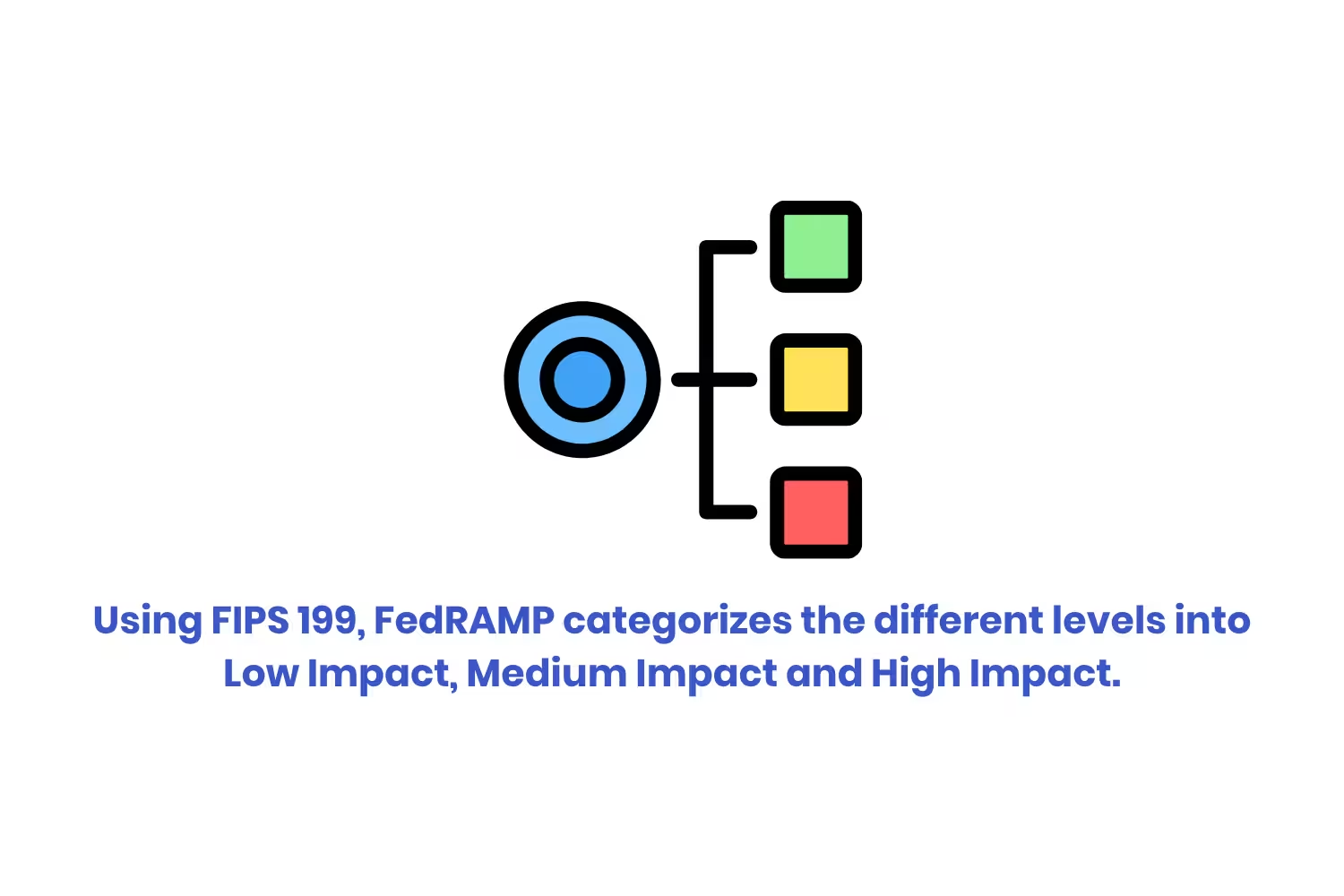
The most common of these is FedRAMP Moderate. Using FIPS 199, FedRAMP categorizes the different levels into the following:
Low Impact: Services that would have a limited adverse effect if compromised. These include over 150 security controls. Tailored Low baseline for non-sensitive systems reduces this to about 70 controls.
Moderate Impact: Services where compromise could have a serious adverse effect on the agency, its assets, or individuals. This baseline includes over 320 controls.
High Impact: Services where compromise could be catastrophic. This is for the government's most sensitive unclassified data. Including law enforcement, emergency services, or financial systems, and requires over 400 controls.
How the FedRAMP Authorization Process Works
The FedRAMP authorization follows a very specific path. This process includes practices from the NIST Risk Management Framework (RMF). This may seem complex at first. So we broke it down for you into these 6 steps:
Categorize and Plan. Everything starts with understanding the sensitivity of the data you’ll be handling. This determines whether your system falls into a Low, Moderate, or High impact level. This first step sets the foundation for everything that follows.
Select and Implement Controls. Define the impact level. Select the appropriate security controls from NIST SP 800-53 and begin implementing them. This is where your security strategy becomes real. Make sure you document all controls in a System Security Plan (SSP).
Prepare for Assessment. With your controls in place, you must now refine your documentation. This ensures your system is ready for review. Align your SSP and clearly define responsibilities. You can do this through supporting materials like a customer responsibility matrix.
Independent Assessment. A Third-Party Assessment Organization (3PAO) steps in to test your environment. Their job is to verify that your controls are not only in place, but actually working.
Authorization Decision. Once the assessment is complete, an authorizing official reviews the findings. It is at this point that they determine whether your system is ready to operate. If approved, you receive an Authorization to Operate (ATO).
Continuous Monitoring. Compliance requires ongoing monitoring, reporting, and periodic reassessments. This proves that your system will stay secure as threats evolve.
The full FedRAMP authorization process typically takes 12-18 months. Covering everything including initiation, preparation, assessment, and continuous monitoring. Some may think this timeline is daunting, and you aren't wrong! But keep in mind this certification positions your organization as a trusted provider. One that meets the security and compliance requirements to handle federal data.
Why is FedRAMP Training So Important?
Completing your FedRAMP training key. It is the only way your company can meet the requirements needed to work with government agencies. It allows for a smoother onboarding process when entering into new partnerships. Without this awareness training, businesses miss out on what might be lucrative opportunities.
So how do you know if you need to get FedRAMP certified? It all depends on whether your cloud service falls within scope. Let's take a look at the four key questions to consider when making that decision:
Does the service fall under the responsibilities of federal agencies to protect sensitive information?
Does the agency need a specific tenant or centralized control?
Will you integrate the tool into federal security services?
Is the service available for use by multiple third parties or agencies?
If you answered “yes” to most of these questions, there’s a chance your service falls within FedRAMP scope. That means pursuing FedRAMP authorization is a requirement to move forward.
If your use case focuses on public-facing content or doesn’t involve sensitive federal data, you may fall out of scope. This is why proper training is so important. It gives you the clarity to make these distinctions early. Especially before you and your team invest a bunch of time and resources into going down the wrong path.
How To Find FedRAMP Courses & Training Provider
Self-paced training modules are one of the most effective ways to meet cloud security requirements. Especially when working toward a FedRAMP cybersecurity service. They allow teams to learn on their own time while still meeting the required security standards.
FedRAMP training covers how to navigate the Marketplace, work with third-party assessors, and apply controls in real-world scenarios. The flexibility of online training courses proves especially valuable since different roles need different levels of depth. Whether that role is a project manager, engineer, compliance officer, or another team member.
Platforms like K2 GRC take this a step further. We integrate self-paced learning directly into your compliance workflow. This in turn helps your teams apply what they learn in real-time. Saving time and helping you move more efficiently toward FedRAMP readiness.
Finding the Perfect FedRAMP Authorized Training For You
Finding a training resource that understands the complexities of FedRAMP is critical. The most effective organizations go a step further by combining their security training with their compliance workflow. While many FedRAMP advisory firms offer great support, platforms like K2 GRC provide a more connected approach.
K2 GRC centralizes governance, risk, and compliance data into a single on-demand system. This helps your team navigate the FedRAMP process with continuous monitoring and real-time visibility. K2 Akademy supports this with a flexible training program, customizable to your current workflow. We take worry out of the equation, ensuring your team can confidently meet FedRAMP requirements.
Our platform also simplifies one of the most stressful aspects of compliance: preparing for an audit. K2 GRC automates evidence collection and maps internal activities directly related to whatever your training covers. We help reduce the time and complexity of achieving FedRAMP readiness. Turning a traditionally long process into a more efficient, manageable path.
Frequently Asked Questions
❓ FedRAMP Frequently Asked Questions
What is the 'do once, use many times' framework?
Before FedRAMP, each federal agency performed its own audit of a cloud provider. Now, once a CSP is authorized, any federal agency can leverage that same security assessment, saving time and millions in taxpayer money.
How do I choose between Low, Moderate, and High impact levels?
This is determined by FIPS 199. Low is for non-sensitive data, Moderate is the standard for most government business, and High is for catastrophic-risk data like law enforcement or emergency services.
How long does it take to get FedRAMP authorized?
Generally, the process takes 12 to 18 months. This timeline includes preparing the System Security Plan (SSP), undergoing an independent assessment by a 3PAO, and receiving the Authorization to Operate (ATO).
What is a 3PAO?
A Third-Party Assessment Organization (3PAO) is an independent body accredited to test a cloud provider's security environment to ensure all NIST controls are implemented and functioning correctly.
Learn how to build an AI risk management policy that addresses governance, risk appetite, AI security risks, regulatory requirements, and ongoing monitoring.
A risk register helps organizations identify, assess, and manage potential risks in one centralized place. Learn the key components of a risk register, how to create and maintain one, and how it supports a more proactive approach to risk management.
New K2 Assist AI, AI-powered Readiness Review, MCP integration and Skills bring AI-driven execution and assessment capabilities to governance, risk, compliance and training workflows.