This blog explains how the proposed HIPAA Security Rule changes could impact healthcare organizations and how mapping these requirements to NIST SP 800-53 can simplify compliance. It highlights major security updates, shares findings from a comprehensive HIPAA-to-NIST crosswalk, and outlines practical steps organizations can take to prepare.
Key Takeaways
✅ Prepare for stricter security requirements: The proposed HIPAA updates introduce clearer expectations for risk assessments, vulnerability scanning, penetration testing, asset inventories, and documented security procedures.
✅ Use NIST SP 800-53 to simplify compliance: Mapping HIPAA requirements to NIST security controls helps organizations understand which safeguards to implement. The updated crosswalk identifies 179 relevant controls and enhancements.
✅ Identify and close compliance gaps: Compare your current security practices against the proposed requirements, establish a centralized System Security Plan (SSP), and implement ongoing monitoring to strengthen your security program.
Who Should Read This?
This guide is ideal for healthcare CISOs, IT security teams, compliance officers, and GRC directors preparing for potential HIPAA Security Rule changes. It's especially useful for organizations looking to understand new technical requirements, identify security gaps, and use NIST SP 800-53 controls to make compliance easier to manage.
Recap significant changes proposed to the HIPAA Security Rule.
Identify the benefits of mapping security requirements to NIST SP 800-53.
Summarize key findings from the new crosswalk.
Describe the methodology used to update these mappings.
Provide a crosswalk to streamline adoption of the proposed HIPAA Security Rule.
Proposed Changes to the HIPAA Security Rule
The HIPAA Security Rule provided a foundational framework for healthcare cybersecurity. Its legal requirements relied on vague administrative rhetoric rather than well-defined controls. The proposed updates represent a paradigm shift. If approved, regulated entities must adopt more explicit technical mechanisms to secure ePHI.
Mandatory Control Testing and Defined Maintenance Frequencies: Under the current rule, Section 164.306(e) served as a catch-all to review security measures "as needed." The proposed update introduces specific maintenance implementation specifications. This shift incorporates CA-02 (Control Assessments) and CA-07 (Continuous Monitoring).
New Network Mapping Requirements. Organizations must now maintain a network map. The map should illustrate how ePHI moves through their information systems.
Comprehensive Technology Asset Inventories. It is no longer enough to simply track the physical movement of hardware. Regulated entities must maintain a written inventory of all technology assets. Inventory details should include specific version numbers, accountable personnel, and physical locations.
Explicit Vulnerability Scanning and Penetration Testing. The current Security Rule does not mandate vulnerability scanning or penetration testing. The proposed update introduces dedicated implementation specifications around vulnerability management. Regulated entities would have to establish schedules for vulnerability scans and penetration testing. This operationalizes RA-5 (Vulnerability Monitoring and Scanning) and CA-8 (Penetration Testing).
Why Map NIST SP 800-53 to the Security Rule?
The HIPAA Security Rule tells you what to protect. NIST SP 800-53 tells you how to technically achieve it. Historically, healthcare entities struggled to translate the Security Rule's safeguards into deployable controls. NIST SP 800-53 provides a comprehensive, standardized catalog of privacy and security controls. By mapping to NIST SP 800-53, organizations can tailor controls that meet regulatory requirements.
Key Findings
Improved Coverage of Moderate Baseline
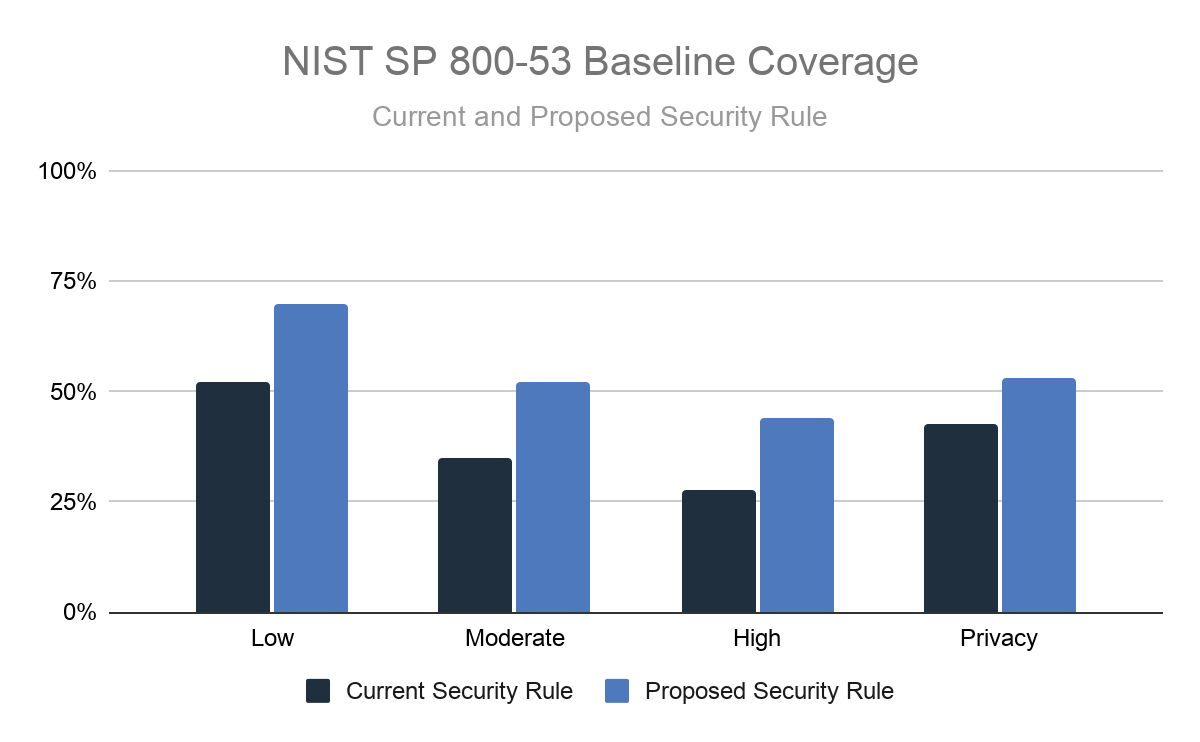
In the proposed rule, the Department stopped relying on vague administrative rhetoric. The NIST OLIR mapping included 108 SP 800-53 controls and control enhancements. We compared these mappings to the baselines defined in NIST SP 800-53B, revealing:
75 mapped controls align to the low baseline
22 align to the moderate baseline
3 align to the high baseline
8 do not align to a security baseline
28 also align to the privacy baseline
Our mapping of the proposed Security Rule included 179 controls and enhancements. Comparing these mappings to the baselines revealed:
104 mapped controls align to the low baseline
46 align to the moderate baseline
12 align to the high baseline
17 do not align to a security baseline
35 also align to the privacy baseline
Emphasis on Technical Domains
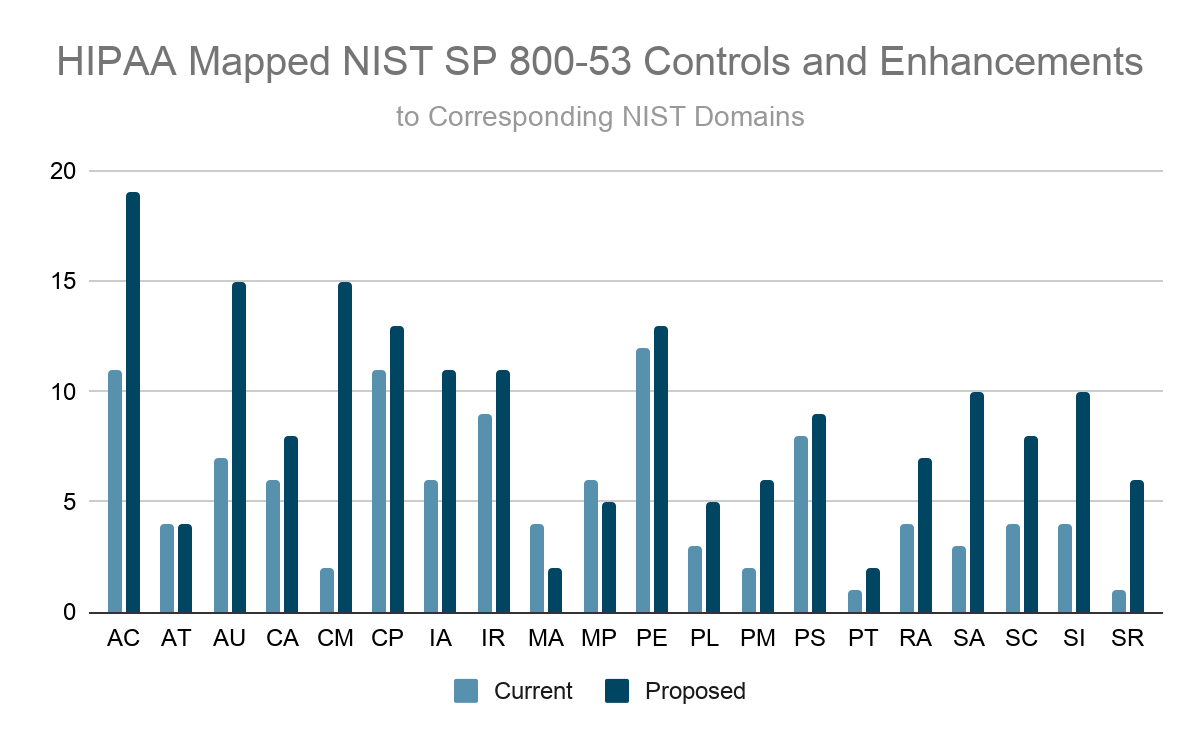
The HIPAA OLIR mapping incorporates controls from all NIST SP 800-53 domains. We also mapped the proposed HIPAA Security Rule to all 20 domains. The configuration management (CM) domain had the largest increase of mapped controls (13). The access control (AC) and audit and accountability (AU) domains each had 8 new controls. Only two domains mapped to fewer controls in the proposed rule. These domains included maintenance (MA) and media protection (MP).
This aligns to one of the key issues addressed by the proposed changes. The Department was concerned regulated entities equated technical safeguards to written policies. By using the term “deploy”, the proposed rule specifies the use of technical controls. This explains the increase in mapped controls within technical domains.
Supportive Relationship Mapping Style
Mapping is often an abstract exercise without explicitly determining the mapping’s purpose. Our intent was to identify controls (SP 800-53) that would satisfy requirements (HIPAA). NIST IR 8477 explains the basics of cybersecurity and privacy concept mapping. The supportive relationship mapping style indicates how a supporting concept helps achieve a supported concept. To assess whether a mapped control supported a requirement, we trained a large language model (LLM) on the supportive relationship types and the properties of these relationships. The assessment included four parts:
Does the individual control support the mapped requirements?
What are the properties of each relationship (integral to, example of, or precedes)?
Do the combined integral and preceding controls satisfy a mapped requirement?
If not, what gaps remain from the requirements not satisfied by the control(s)?
The LLM assessment of the NIST OLIR mapping showed that NIST controls only satisfied 35 of the 68 HIPAA requirements. This finding correlates with the executive summary of NIST SP 800-66r2, which stated the mapping goals as:
Providing guidance on assessing and managing risks to ePHI.
Identifying typical activities to consider as part of an information security program.
Listing resources that regulated entities may find useful when implementing the Security Rule.
The executive summary also notes that organizations can implement the Security Rule more effectively when they have a list of controls that meet each standard. With the help of APS Global, our mapping covers all proposed safeguard standards and implementation specifications. We describe our methodology in more detail below.
Methodology
The NIST OLIR mapping of the current HIPAA Security Rule and NIST SP 800-53r5 was our starting point. We organized this mapping on two tabs. Each tab listed the unique concepts from each framework to see their relationship to the other publication. Leveraging our crosswalk between HIPAA Security Rule to the proposed updates, we created a derived relationship map between NIST SP 800-53 and the proposed updates. This derived relationship map showed potential relationships for parts of the proposed Security Rule that had lineage with the current standard. In keeping with guidance from NIST IR 8477, we assessed the relationships using the supportive relationship mapping style.
Leveraging Large Language Models (LLM)
We incorporated a LLM to assess whether the mapped controls supported the requirements. We engineered a prompt to categorize the relationships between controls and requirements as follows:
Supports: Concept A supports concept B.
Supported by: Concept B supports concept A.
Identical: They use exactly the same wording.
Equivalent: They have the same meaning but different wording.
Contrary:
No relationship:
We kept equivalent and supportive relationships and removed pairings typified as no relationship. The LLM categorized most of the relationships as NIST controls supporting HIPAA requirements. Next, we had the LLM establish properties for equivalent and supportive relationships. These properties values included:
Example of: The supporting concept is an example of achieving the supported concept.
Integral to: The supporting concept is integral to the supported concept.
Precedes: The supportive concept must be achieved before applying the supported concept.
We removed a few controls defined as examples of requirements. This left us with a mapping of supportive controls that were either integral to or preceding requirements. After aligning the requirement text with mapped control descriptions, we prompted the LLM to assess whether the controls satisfied the requirements. When they did not, we asked the LLM to identify the gap.
To close the gaps, we revisited the language within the Notice of Proposed Rulemaking and chased the footnotes through the Healthcare and Public Health (HPH) Cybersecurity Performance Goals (CPGs). We proposed potential mappings to the LLM and refined through an iterative process. We organized the mappings into two tabs, each using one set of concepts as the focal document.
Independent Review
We collaborated with our friends at APS Global for their independent review. Their team, led by Dr. Hansen, has trained a LLM to assist with the assessment of NIST-based frameworks. Their review provided an authoritative validation of the updated control mappings.
Next Steps for CISOs and GRC Directors
The runway to adopt these proposed changes is narrowing. We recommend the following steps to prepare your organization for the shift toward explicit technical mandates:
Conduct a Baseline Gap Assessment. Compare your current security program against the mapped NIST controls. Pay special attention to technical domains like Access Control (AC) and Configuration Management (CM).
Formalize Your System Security Plan (SSP). Move away from disjointed policy documents. Adopt a GRC platform to generate and maintain a centralized SSP that dynamically tracks your control implementation and maintenance frequencies.
Operationalize Continuous Monitoring. Establish automated workflows for your newly required vulnerability scans, penetration tests, and control effectiveness reviews to ensure you never fall out of compliance.
Conclusion
The proposed HIPAA Security Rule marks a pivotal shift in healthcare regulatory compliance. The Department is raising the bar for how regulated entities protect ePHI. This evolution emphasizes technical domains, pushing healthcare organizations closer to the NIST moderate baseline. Relying on an abstract view of these updates leaves organizations vulnerable to compliance gaps. By leveraging advanced LLM analysis and authoritative independent review, our supportive relationship mapping goes beyond simple framework cross-referencing. It acts as a tactical guide, identifying exactly which NIST SP 800-53 controls satisfy the new HIPAA mandates. To help you streamline adoption, we’ve made our comprehensive mapping available as a free resource.
❓ Frequently Asked Questions About the HIPAA Security Rule and NIST SP 800-53
Is NIST SP 800-53 mandatory for HIPAA compliance?
No, NIST SP 800-53 is not explicitly required for HIPAA compliance. However, the Department of Health and Human Services (HHS) uses NIST frameworks to help define reasonable and appropriate security measures. Mapping the HIPAA Security Rule to NIST SP 800-53 can help healthcare organizations identify and implement controls that support compliance.
What is the difference between HIPAA and NIST SP 800-53?
HIPAA establishes federal requirements for protecting electronic protected health information (ePHI), while NIST SP 800-53 provides a detailed catalog of security and privacy controls. HIPAA defines what healthcare organizations must protect, and NIST SP 800-53 offers practical safeguards to help meet those requirements. Using both frameworks together can make security planning and compliance management easier.
How many NIST SP 800-53 controls map to the proposed HIPAA Security Rule?
Our HIPAA Security Rule to NIST SP 800-53 crosswalk identifies 179 controls and enhancements that support the proposed requirements. This represents a significant increase from the 108 controls and enhancements included in the existing NIST mapping. The expanded mapping reflects a greater emphasis on technical security safeguards, continuous monitoring, and documented compliance activities.
What are the major changes in the proposed HIPAA Security Rule?
The proposed HIPAA Security Rule introduces more specific cybersecurity requirements, including annual risk assessments, vulnerability scanning, penetration testing, and detailed technology asset inventories. It also emphasizes written security procedures, network mapping, and ongoing security control testing. If finalized as proposed, these changes would require healthcare organizations to take a more structured approach to protecting ePHI.
What is a HIPAA to NIST SP 800-53 crosswalk?
A HIPAA to NIST SP 800-53 crosswalk is a reference tool that connects HIPAA Security Rule requirements to relevant NIST security and privacy controls. It helps organizations understand which technical safeguards can support specific regulatory requirements. Healthcare compliance teams can use a crosswalk to assess existing controls, identify security gaps, and plan improvements.
How can healthcare organizations prepare for the proposed HIPAA Security Rule changes?
Healthcare organizations can begin by conducting a gap assessment that compares their current security practices against the proposed HIPAA requirements. Using a HIPAA Security Rule to NIST SP 800-53 crosswalk can help identify missing controls and prioritize improvements. Organizations should also consider developing a centralized System Security Plan (SSP), documenting security procedures, and establishing regular vulnerability assessments and monitoring processes.
How does NIST SP 800-53 help healthcare organizations achieve HIPAA compliance?
NIST SP 800-53 provides specific security controls that healthcare organizations can use to address HIPAA Security Rule requirements. These controls cover areas such as access management, risk assessments, system monitoring, and configuration management. By mapping HIPAA requirements to NIST SP 800-53, organizations can build a more structured security program, identify compliance gaps, and improve their protection of patient information.
Explore the proposed HIPAA Security Rule changes and how mapping requirements to NIST SP 800-53 helps healthcare organizations identify compliance gaps, strengthen security controls, and prepare for new requirements.
Explore the proposed HIPAA Security Rule changes and updates, including new cybersecurity requirements, compliance deadlines, and steps healthcare organizations can take to prepare.
See how the proposed HIPAA Security Rule technical safeguards change MFA, encryption, and testing, with a 2013-to-2027 crosswalk for your gap analysis.